How to Pick the Right Storage Unit for Your Needs
Choosing storage sounds simple until you actually have to do it. Over the past decade, SafeStorage has served more than 1 lakh customers across 16+ cities, and if there is one pattern we see repeated every single day, it is this: most people do not know how to pick the right storage unit for their needs, and the cost of that confusion is real money. They book space that is too large and pay for air. They book space that is too small and face stressful last-minute upgrades. They choose a facility on price alone and discover, months later, that humidity, pests, or poor handling have damaged goods worth far more than whatever they saved. This guide distills everything we have learned from a decade of storing households, businesses, vehicles, and documents into a practical, step-by-step method. By the end, you will know exactly how to pick the right storage unit — the right size, the right type, the right duration, and the right provider — with the confidence of someone who has done it a hundred times.
Why Picking the Right Storage Unit Matters More Than You Think
A storage decision looks like a small logistics task, but it is really a financial and emotional decision rolled into one. Financially, the gap between a well-chosen and poorly-chosen unit can be 30 to 50 percent of your monthly bill — either because you are paying for unused space or because hidden charges inflate a 'cheap' headline rate. Emotionally, the goods you store are rarely just objects. They are your child's first cycle, your wedding furniture, your parents' belongings, your business inventory. When customers come to us after a bad experience elsewhere, the complaint is almost never about price. It is about a damaged mattress, a missing carton, a termite-eaten wardrobe. Learning how to pick the right storage unit protects you from both kinds of loss at once.
Step 1: Start With What You Are Storing, Not Where
The most common mistake we see is that people begin by searching for storage near their home and only afterwards think about what is actually going in. Reverse the order. Walk through your house with your phone and make a quick video of everything you intend to store. Note the large items first — beds, wardrobes, sofas, dining tables, refrigerators, washing machines — because these define the volume. Then count cartons of smaller items in rough batches of ten. This ten-minute exercise does more to help you pick the right storage unit than an hour of comparing websites, because every other decision — size, type, price, even provider — flows from this list. At SafeStorage, our team can quote accurately from exactly this kind of WhatsApp video, which is why our quotes rarely change at pickup.
Step 2: Estimate Volume the Smart Way
Traditional storage forces you to choose a fixed room size — 50 sq ft, 100 sq ft, 200 sq ft — and most first-time customers have no intuition for what those numbers mean. The smarter modern approach is volume-based pricing, where you pay for the cubic feet your goods occupy rather than a room that sits one-third empty. As a practical anchor, here is what our decade of data shows. Goods from a typical 1 BHK home — a bed, a wardrobe, a fridge, a washing machine, and fifteen to twenty cartons — generally cost between 1,299 per month to store. A 2 BHK household with additional furniture and appliances usually falls in the range of 3,499 per month. A complete 3 BHK home with large sofas, multiple wardrobes, dining sets, and extensive cartons typically runs from 5,999 per month. Small loads — a two-wheeler, a few boxes, a single appliance — start at just 99 per month. If a provider cannot translate your item list into a clear volume-based price, that is a signal to keep looking. The right storage unit is one you are not paying to keep empty.
Step 3: Match the Duration to Your Real Timeline
Duration changes everything about how you should pick the right storage unit. For short-term storage — a home renovation, a gap between rental agreements, a two-month trip — flexibility matters more than anything else. You need zero lock-in, month-to-month billing, and fast retrieval. For long-term storage — an overseas posting, a multi-year assignment in another city, downsizing after retirement — the priorities shift to packing quality, pest control, and periodic facility audits, because goods sitting for two years face risks that goods sitting for two months do not. Our honest advice from experience: always assume your storage period will run longer than you plan. Around 60 percent of our customers extend beyond their original estimate. This is exactly why we built SafeStorage with zero lock-in and zero deposit — your plan should bend with your life, not the other way around. Never sign a long commitment for a discount; the flexibility you give up is worth more than the rupees you save.
Step 4: Choose the Right Type of Storage for Your Situation
Not all storage is the same product, and picking the right category is half the decision.
1. Household Storage
The most common need: full or partial home contents during relocation, renovation, travel, or transition between houses. Look for professional packing, item-level inventory, and doorstep pickup, because furniture and appliances are damaged in transit far more often than in storage itself.
2. Business and Inventory Storage
Traders, e-commerce sellers, and offices need something different: scalability. Inventory swells before festive seasons and shrinks after. The right storage unit for a business is one where you can scale volume up and down monthly without renegotiating a lease — something a traditional godown contract simply cannot offer.
3.Vehicle Storage
Two-wheelers and cars left behind during long trips need covered, secured parking with periodic checks. An apartment basement is not vehicle storage; batteries die, tyres deflate, and society rules change. Dedicated vehicle storage keeps your vehicle ready for your return.
4. Document and Archive Storage
Businesses storing files, records, and compliance documents should prioritise barcode-level retrieval — the ability to call for one specific carton without disturbing the rest. If a provider can only return your entire lot, your documents are warehoused, not managed.
Step 5: Evaluate Security Like a Professional
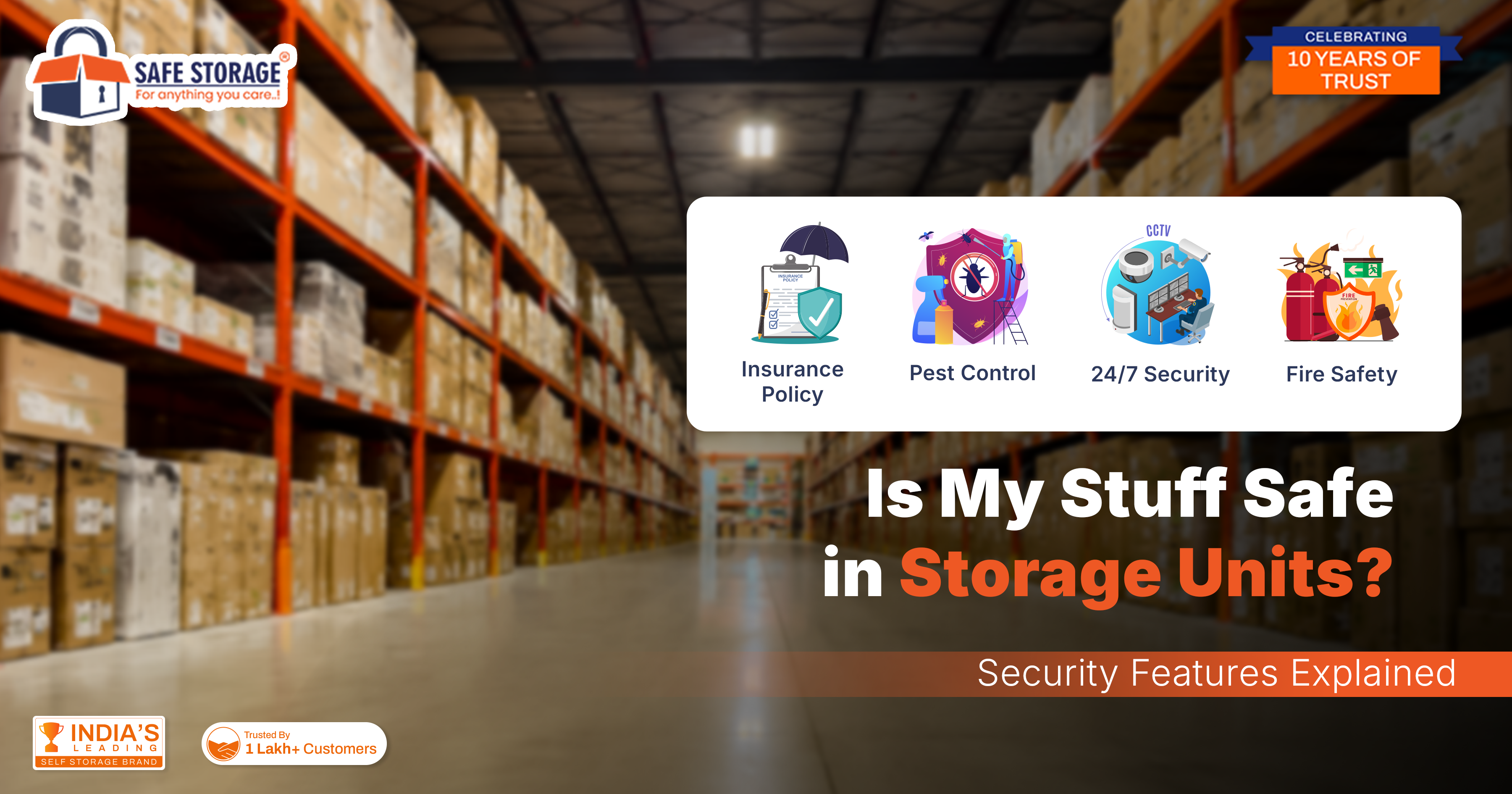
Here is how we audit our own facilities, and how you should audit any provider before you decide. First, 24/7 CCTV surveillance — not a camera at the gate, but coverage across storage areas with recorded footage. Second, biometric access control, which ensures only authorised staff enter storage zones; a padlock and a security guard is not access control. Third, barcode inventory tracking — every single item tagged, scanned, and listed digitally at pickup, so there is never a dispute about what was stored. Fourth, fire safety systems and routine pest control, which matter more in Indian conditions than almost anywhere else. When you pick the right storage unit, you are really picking a security system with shelves inside it. At SafeStorage, every one of these is standard with every plan, including the 99 entry tier — security is never a paid add-on.
Step 6: Account for Climate, Humidity, and Pests
This is the factor almost every first-time customer ignores and almost every second-time customer asks about first. Indian summers, coastal humidity, and monsoon months are brutal on stored goods. Wooden furniture warps and invites termites in damp facilities. Mattresses and sofas absorb moisture and develop fungus. Electronics corrode. When you inspect or evaluate a facility, ask three questions: Is the storage area elevated and protected from water ingress? Is there ventilation that keeps humidity in check? Is pest control done on a fixed schedule with records? A facility that hesitates on any of these answers is a facility that will hand you back damaged goods. In our experience, climate-related damage — not theft — is the number one risk in Indian storage, and it is the clearest line between professional facilities and informal godowns.
Step 7: Compare True Cost, Not Headline Rent
A 1,800 quote can be cheaper than a 1,200 quote. Here is the arithmetic customers discover too late. The 1,200 godown adds a security deposit of two or three months, charges separately for loading and unloading, expects you to arrange and pay for transport both ways, sells you packing material, and sometimes surprises you with 'handling charges' at retrieval. The 1,800 all-inclusive plan covers doorstep pickup, professional packing, transport, insurance-grade handling, and delivery back to your door. To pick the right storage unit on cost, build a simple total: monthly rent multiplied by realistic duration, plus deposit, plus transport both ways, plus packing, plus retrieval charges. Compare that number, not the advertised rate. SafeStorage quotes one transparent all-inclusive figure with zero deposit precisely so this comparison is easy — and it is a major reason behind our 4.9-star rating across 9,000+ Google reviews.
Step 8: Weigh Doorstep Pickup Against Self-Drop
Traditional self-storage assumes you will hire a tempo, find labour, transport your goods across the city, and carry them into a unit yourself — then repeat the entire exercise in reverse later. For a few boxes, that may be fine. For a household, it is a full day of physical work, two transport bills, and the highest-risk part of the entire storage journey, because most damage happens in amateur loading and unloading.Full-service storage with doorstep pickup and delivery sends a trained crew to your home with professional packing material, wraps and barcodes every item, and handles transport in vehicles designed for the job. When customers tell us SafeStorage felt effortless, this is the step they are describing. If your goods include furniture or appliances, doorstep service is not a luxury — it is how you pick the right storage unit without breaking your back or your dining table.
Common Mistakes We See Every Week
After a decade and 1 lakh+ customers, the mistakes are remarkably predictable. Overestimating space: customers mentally allocate a whole room when their actual goods occupy a third of it; volume-based pricing fixes this automatically. Forgetting items: balconies, lofts, and store rooms are invisible until pickup day — walk every space when making your list. Storing things that should be sold or donated: paying 300 a month for years to store a 2,000 table is sentiment, not strategy; we genuinely advise customers to declutter first, even though it reduces our bill. Choosing on distance: with doorstep pickup, a facility's location is irrelevant to you — service quality is everything. Ignoring the inventory list: if a provider does not document every item at pickup, you have no protection at retrieval. Avoiding these five mistakes puts you ahead of ninety percent of first-time storage customers.
Real Examples: Three Customers, Three Right Answers
The Bengaluru techie heading onsite. An engineer received an eighteen-month deployment abroad. The wrong answer was keeping his 25,000-per-month flat as a giant cupboard. The right storage unit was a volume-based household plan at under 2,500 per month with long-term packing — a saving of over ?4 lakh, with everything delivered to his new flat on return.
The growing family between homes. A family sold their flat before the new one was ready, creating a five-month gap. They needed short-term storage with fast, partial retrieval — they called back twice for specific cartons of school books and winter clothes. Barcode-level inventory made each retrieval a single delivery, not an excavation.
The festive-season trader. A small business needed triple its usual space for three months before Diwali. A godown lease would have locked a year's commitment for a quarter's need. Scalable business storage let him pay for exactly the volume and months he used, then shrink back in January.
Three different needs, three different right answers — but one common method: start from the goods, match the duration, verify the security, and compare the true cost.
Red Flags That Mean You Should Walk Away
Sometimes the fastest way to pick the right storage unit is to recognise the wrong one early. Walk away from any provider that refuses to give a written, all-inclusive quote — verbal estimates have a habit of growing at delivery time. Walk away if there is no item-level inventory process; a provider that does not document your goods at pickup has no obligation to account for them at retrieval. Walk away from facilities you are discouraged from visiting or seeing on video, from contracts with retrieval charges that are 'decided later', and from any arrangement where your goods share open floor space with unknown third-party material — mixed open storage is how pests, moisture, and mix-ups travel from someone else's goods to yours. Be equally cautious about deposits larger than one month's rent and lock-ins longer than your honest timeline. None of these red flags is about price; every one of them is about accountability. In ten years we have found that the providers who resist transparency on paper are the same ones who resist responsibility when something goes wrong. The right storage unit comes with paperwork you can hold someone to — a quote, an inventory, a retrieval term — and a team that volunteers all three before you even ask.
One more practical test from our experience: call the provider and ask a slightly difficult question, such as how termite control is scheduled or what happens if an item is damaged in transit. A professional operation answers immediately and specifically, because the process exists. An informal one improvises. Sixty seconds on the phone can reveal more than an hour on a website, and it costs you nothing before you pick the right storage unit for goods you genuinely care about.
The SafeStorage 10-Point Checklist
Before you book anywhere, run this checklist. One: a complete item list or video of what you are storing. Two: a volume-based quote, not a fixed room. Three: zero deposit. Four: zero lock-in with month-to-month billing. Five: doorstep pickup and delivery included. Six: professional packing material and trained crew. Seven: barcode inventory with a digital list shared to you. Eight: 24/7 CCTV and biometric access at the facility. Nine: documented pest control and fire safety. Ten: a single all-inclusive price with retrieval terms in writing. Any provider that clears all ten is a safe choice. SafeStorage was built to clear all ten by default — it is how we have grown to 3M+ sq ft of storage space across 16+ cities while holding a 4.9-star rating.
Frequently Asked Questions
1. What size storage unit do I need for a 2 BHK home?
With volume-based pricing you do not need to guess a size. A typical 2 BHK household costs between 3,999 per month, and the exact figure comes from your item list — share a video and you get a precise quote.
2. Is it cheaper to store goods or keep paying rent on my flat?
Storage almost always wins. Storing a full household costs a fraction of urban rent, which is why customers relocating or travelling long-term save lakhs by storing instead of holding an empty flat.
3. How do I pick the right storage unit for long-term storage?
Prioritise packing quality, pest control, ventilation, and inventory documentation over headline price. For multi-year storage, the condition of your goods at retrieval is the real measure of value.
4. Can I access my items while they are in storage?
Yes. With barcode inventory, you can request specific items for doorstep delivery or schedule a facility visit — without disturbing the rest of your stored goods.
Conclusion: Pick the Right Storage Unit Once, Relax for Months
Knowing how to pick the right storage unit comes down to a sequence anyone can follow: list your goods, price by volume, match the duration honestly, choose the correct storage type, verify security and climate protection, and compare all-inclusive cost rather than headline rent. Get the sequence right and storage becomes what it should be — an invisible, reliable extension of your home or business. SafeStorage offers plans starting at 99 per month with zero deposit, zero lock-in, free doorstep pickup, professional packing, barcode tracking, and facilities protected by 24/7 CCTV and biometric access, trusted by more than 1 lakh customers with a 4.9-star rating across 9,000+ Google reviews. One call, one video of your goods, one transparent quote — and your storage decision is done right the first time.
Pick the Right Storage Unit Today — Call 8088848484 or Visit safestorage.in for a Free Volume Assessmen
.png)
💬 Comments
Leave a Comment