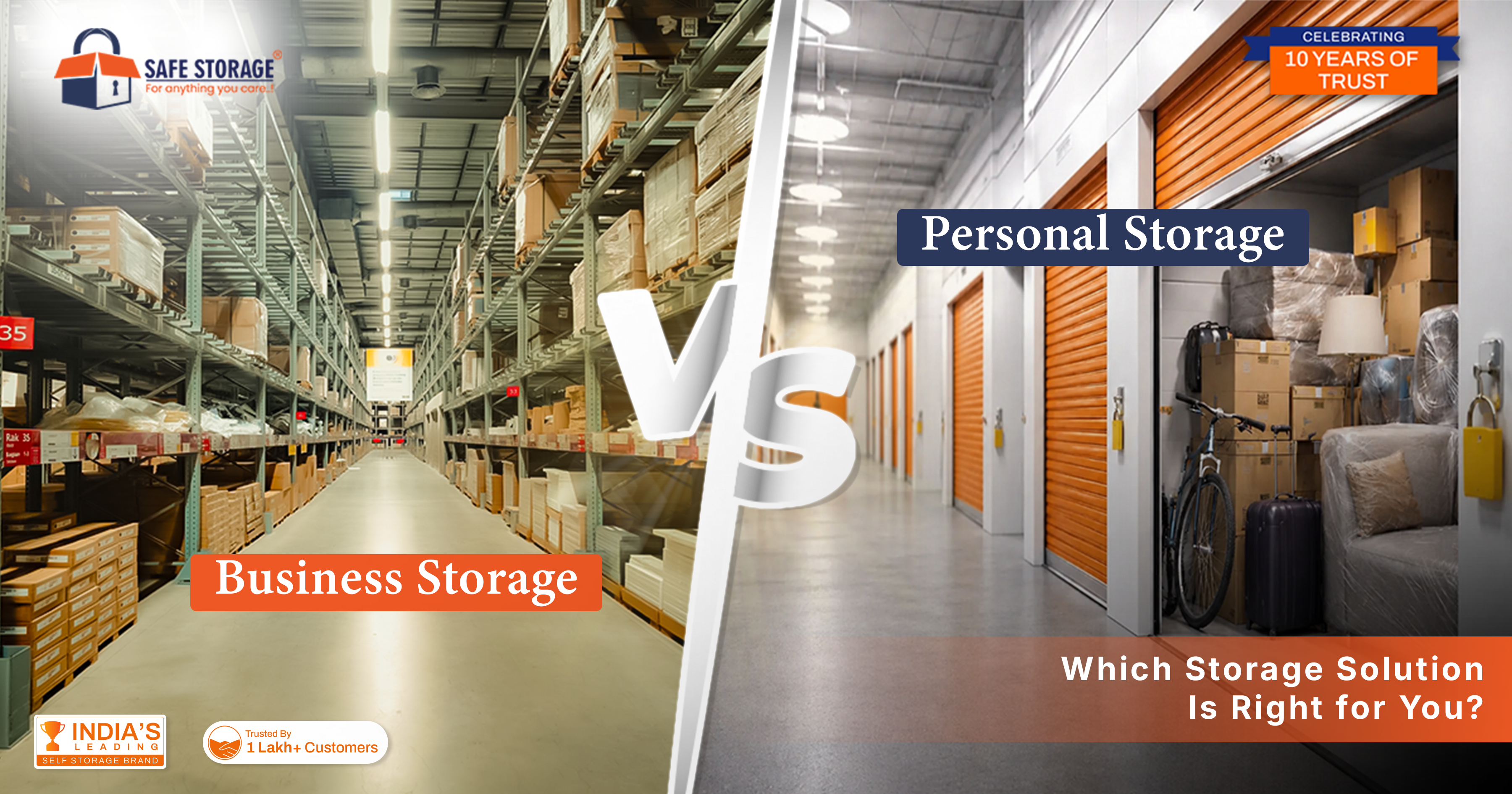
Business Storage vs Personal Storage: Which Storage Solution Is Right for You?
People ask me this more than almost anything else: “Do I need business storage or personal storage?” And nine times out of ten they’re surprised by the answer, because the honest reply is — it depends less on who you are and more on what you’re actually storing, how often you need to get to it, and what happens if something goes wrong.
A freelancer storing a few cartons of stock is a business user even if they work from a bedroom. A retired couple keeping their late father’s furniture is a personal user even if the pile is bigger than most shop inventories. So when people frame it as business storage vs personal storage, what they’re really asking is: which setup fits my situation, my budget, and my peace of mind? That’s the question this guide actually answers.
At SafeStorage we’ve handled both ends of this for over a lakh customers across 16-plus cities — everything from a single wardrobe to a company’s entire document archive. This is the no-nonsense breakdown I’d give a friend over chai: what each option is for, where they overlap, what they cost, and how to pick without second-guessing yourself a month later.
First, What Do We Even Mean by Each?
Before we can compare them properly, let’s be clear about what we’re comparing. The whole business storage vs personal storage debate gets muddy because people assume the unit is different. It usually isn’t. The space is the same secure space. What changes is the purpose, the access pattern, and the paperwork around it.
1. Personal storage, in plain terms
Personal storage is for your life’s stuff. The furniture that won’t fit during a renovation, the boxes you can’t face during a move, your bike over monsoon, the appliances you’re not ready to sell. It’s things you own as a person, stored for reasons that are usually about time, space, or a life event — a move, a marriage, a posting abroad, a parent’s home being cleared. You don’t need it daily. You need it safe, and you need it back when you’re ready.
2. Business storage, in plain terms
Business storage is for the things that keep your work running — stock and inventory, equipment, files and records, seasonal displays, sample units, e-commerce parcels waiting to ship. The defining feature isn’t size; it’s rhythm. A business often needs to get in and out regularly, track what’s there, and sometimes scale the space up or down as orders rise and fall. That’s the real fault line in business storage vs personal storage — personal storage tends to sit still, business storage tends to move.
3. The Honest Side-by-Side
Here’s how the two stack up on the things that actually matter, laid out plainly so you can see where you land.
4. Access frequency
Personal storage is usually a “store it and forget it for a while” arrangement — you might visit once a month, or not until the move-out day. Business storage often needs frequent, sometimes weekly or daily, access. If you’re reaching for your goods all the time, you want a setup built around easy retrieval, not one designed for long undisturbed rest.
5. What’s being stored
Personal is household: furniture, clothes, books, appliances, sentimental boxes. Business is operational: inventory, machinery, documents, marketing material, packed orders. The handling needs differ — a sofa just needs space; a stack of GST records needs to stay organised and findable.
6. Volume and how it changes
Personal volume is fairly fixed — you store a 2 BHK’s worth and that’s roughly that until you move it out. Business volume breathes. A retailer balloons before Diwali and shrinks after. So businesses care a lot about flexible, scalable space and zero lock-in, while personal users care more about a steady, predictable monthly rate.
7. Documentation
This is where they genuinely part ways. Personal storage is light on paperwork. Business storage may need proper invoicing, GST-compliant billing for your accounts, and clean records you can hand your auditor. If you’re a registered business, that paperwork isn’t a nicety — it’s how the expense becomes claimable.
The Benefits — Spelled Out for Both Sides
Whichever way you lean, the core promise is the same: your things, somewhere safer and more convenient than wherever they are now. But the wins look a little different depending on which side of business storage vs personal storage you’re on.
Why personal storage earns its keep
1. It buys you space without buying a bigger home. Far cheaper than renting a larger flat just to hold furniture you use twice a year.
2. It carries you through life’s transitions. Moves, renovations, foreign postings, weddings — the messy in-between periods where your stuff needs a safe home.
3. It protects what you can’t replace. With 24/7 CCTV, biometric access, and barcode tracking, sentimental and valuable items sit safer than in a spare room.
4. No haggling, no hassle.Doorstep pickup and delivery mean you don’t rent a tempo or beg a cousin with a van.
Why business storage pays for itself
1. It frees up expensive premises. Why pay shop or office rent to warehouse boxes? Move dead stock and records out and use your prime space to actually sell or work.
2. It flexes with your season. Scale up before the festive rush, scale down after, and with zero lock-in you’re never paying for space you’ve stopped needing.
3. It keeps records audit-ready. Documents stay organised, tracked, and retrievable — a lifesaver when an auditor or a customer query lands.
4. It’s a clean, claimable expense. Proper invoicing turns storage into a tidy line on your books rather than a grey personal cost.
How to Actually Decide (A Two-Minute Self-Test)
Forget the labels for a second. Run yourself through these questions and the answer to business storage vs personal storage usually settles itself.
1. How often will I open the unit? Rarely — lean personal. Often — lean business, and prioritise easy access.
2. Is this for my household or my work? If the goods earn you money, treat it as business storage even if you’re a one-person shop.
3. Will the volume change? Steady points to personal. Seasonal spikes point to scalable business storage.
4. Do I need an invoice for accounts or GST? If yes, you want a business storage arrangement set up for proper billing.
5. What’s the cost of something going missing? Either way, insist on real security — CCTV, biometrics, item-level tracking — but business goods especially need that audit trail.
Most people land cleanly on one side after that. And if you’re genuinely in both camps — say, a homepreneur storing personal furniture and product stock — there’s no rule against running two arrangements, or one larger unit, whichever works out simpler and cheaper for you.
The Mix-Ups I See All the Time
After enough years of this, the same misunderstandings keep walking through the door. Worth knowing them so you don’t repeat them.
1. Assuming business storage is pricier by nature. It isn’t — you pay for space and services, not for the word “business” on the booking.
2. Storing business stock at home to “save money,” then losing far more in cluttered premises, damaged goods, and no proper records.
3. Picking personal storage for inventory, then realising there’s no clean invoice for the accountant at year-end.
4. Over-renting a giant unit for a small, steady personal load instead of right-sizing it.
5. Choosing a cheap, unmonitored shed for either purpose and gambling with things that actually matter.
What About the Cost?
Let’s talk money, because it’s usually the deciding vote. The good news with business storage vs personal storage is that the pricing logic is the same and refreshingly simple: you pay for the space your goods occupy, starting at just 99 a month, with zero deposit and zero lock-in. Nobody’s charging you extra for calling it business or personal.
For personal use, cost tracks your home size — a 1 BHK’s worth of belongings fits a compact unit, a 2 BHK a mid-sized one, a 3 BHK or villa a larger one. For business use, it tracks your inventory volume and how fast it turns over, with the freedom to scale the space as your season demands. Either way, once you fold in doorstep pickup and delivery, most people find storage works out cheaper than the alternative they were about to settle for — a bigger flat, extra shop rent, or a half-empty warehouse on a long lease.
One Thing Neither Side Should Compromise On
Whatever you’re storing, security is non-negotiable. This is the part where the cheap option costs you the most. Every SafeStorage facility runs round-the-clock CCTV, biometric access so only authorised people get in, and barcode tracking so every box and item is logged. For a family, that means your grandmother’s almirah is watched over properly. For a business, it means your stock and records have a clean chain of custody you can actually rely on. The business storage vs personal storage question matters, but it’s a distant second to “is my stuff genuinely safe?” Get that right first.
Frequently Asked Questions (FAQs)
1. What’s the core difference in business storage vs personal storage?
It’s mostly purpose and rhythm, not the unit itself. Personal storage holds household goods that mostly sit still; business storage holds work goods you often access, track, and scale. In the business storage vs personal storage choice, ask how you’ll use the space, not who you are.
2. Is business storage more expensive than personal storage?
Not by default. With SafeStorage you pay for the space your goods take up, from 99 a month, with zero deposit and zero lock-in. The “business” label doesn’t add cost — services like extra access or invoicing are what vary, not the word itself.
3. Can I store business inventory in a personal storage unit?
You can store goods either way, but if it’s for your work you’ll usually want a business arrangement so your billing and records are clean. Treating inventory as personal storage often leaves you without the invoice your accountant needs at year-end.
4. Which is right if I run a small business from home?
Lean business storage for the work goods, even as a one-person operation. The deciding factor in business storage vs personal storage is whether the items earn you money and need tracking — not whether you have a fancy office.
5. Do I get a proper invoice for business storage?
Yes. Business storage can be set up with proper invoicing so the cost slots neatly into your accounts. That paperwork is exactly what separates a claimable business expense from a vague personal one.
6. How often can I access my stored items?
As often as you need. Personal users often visit rarely; business users may need frequent access, and we set that up accordingly. Tell us your access pattern up front so the arrangement fits how you’ll actually use it.
7. Are my goods safe either way?
Completely. Both personal and business storage sit in the same secure facilities — 24/7 CCTV, biometric access, and barcode tracking. Security never depends on which side of the business storage vs personal storage line you fall on.
8. Can I scale my storage up or down?
Yes, and businesses lean on this hard. With zero lock-in you can expand before a busy season and shrink after, so you’re never paying for empty space. Personal users can resize too whenever their needs change.
9. Do I have to transport everything myself?
No. SafeStorage offers doorstep pickup and delivery for both. We collect from your home or premises and deliver back when you’re ready — no hired tempo, no borrowed van, for either personal or business goods.
10. What if I need both at once?
Plenty of people do, and it’s fine. You can run separate personal and business arrangements, or a single larger unit, whichever is simpler and cheaper for your case. Just tell us what you’re storing and we’ll sort the cleanest setup.
Two Quick Stories That Show the Difference
Sometimes the cleanest way to understand business storage vs personal storage is to watch it play out. Here are two situations we see constantly, stripped down to the decision that mattered.
1. The family mid-renovation
A couple in a 2 BHK decided to redo their kitchen and bedrooms. For about two months their home was a building site, and the furniture had nowhere safe to be. They went with personal storage — a mid-sized unit, doorstep pickup, and not a single visit until the work was done. Their wooden furniture stayed dust-free and scratch-free, the workers had room to actually do their job, and when the renovation wrapped, one call brought everything home. No access during the period, no fuss, low cost. Classic personal storage: store it, forget it, get it back.
2. The online seller before the festive rush
A small e-commerce seller used to stack inventory in the spare room, and every Diwali it spilled into the living room, the hallway, eventually the kids’ study. Orders got mixed up, a few items went missing, and there was no clean record of any of it. They switched to business storage: a unit they could access often, scale up before the rush and trim after, with proper invoicing for their books. Suddenly their home was a home again, stock was tracked, and the storage cost sat neatly on their accounts as a claimable expense. That’s the heart of business storage vs personal storage — same shelves, completely different way of living with them.
Final Thoughts
Here’s the thing I keep coming back to: the business storage vs personal storage question feels like a big decision, but it’s really a small one once you stop worrying about labels and start looking at how you’ll use the space. Storing your life? That’s personal — keep it safe and get it back when you need it. Storing your livelihood? That’s business — keep it accessible, trackable, and on the books. The walls are the same; the way you live with them is what differs.
So don’t overthink it. Run the two-minute self-test, be honest about access and paperwork, and never trade away security to save a few rupees. Whether it’s a wardrobe full of memories or a season’s worth of stock, the right call is the one that fits how you actually operate. With 99-a-month pricing, zero deposit, zero lock-in, doorstep pickup and delivery, and secure facilities across 16-plus cities, the business storage vs personal storage decision stops being a dilemma and starts being easy. Tell us what you’re storing — we’ll help you land on the right side without the guesswork.
Not Sure Which One You Need? Let’s Figure It Out.
Call 8088848484 | Visit safestorage.in
From 99/month | Zero Deposit | Zero Lock-in | Doorstep Pickup & Delivery

💬 Comments
Leave a Comment