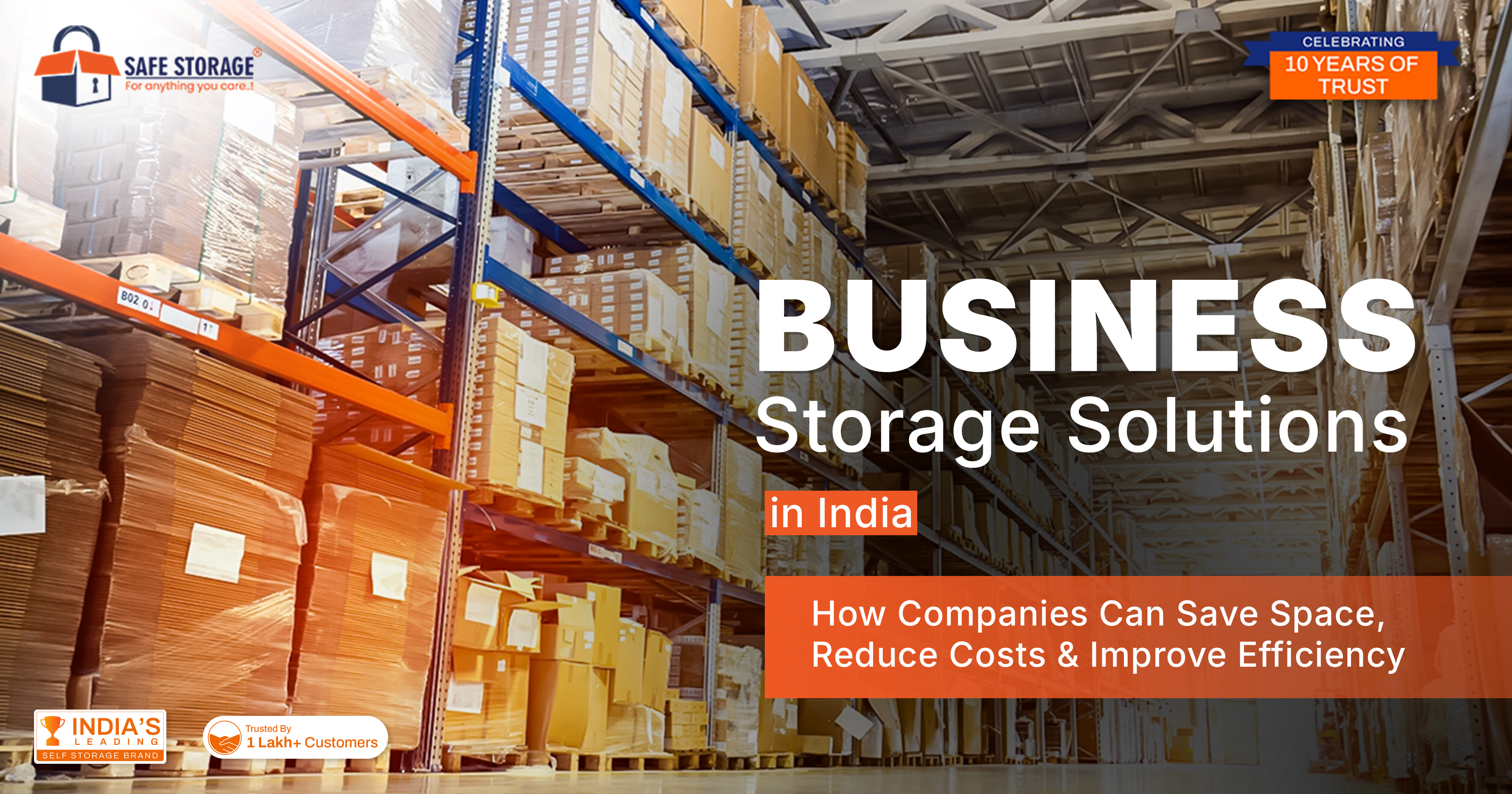
Business Storage Solutions in India: How Companies Can Save Space, Reduce Costs & Improve Efficiency
Most business owners don't think about storage until it becomes a problem. The stockroom is overflowing, the office has boxes stacked in every corner, or the rent on a space that's half-full of old files and dead inventory suddenly feels indefensible. After running SafeStorage across more than sixteen cities since 2015 and working with everyone from small retailers to growing e-commerce brands, I've seen the same pattern again and again: companies pay premium commercial rent to store things that don't need premium commercial space.
This guide is about fixing that. Whether you're a shop owner buried in seasonal stock, an online seller juggling overflow during festival season, or an office trying to shed square footage, the right storage setup can free up space, cut your monthly costs, and make the whole operation run smoother. Here's how it actually works.
Why Indian Businesses Outgrow Their Space
The core problem is simple. Commercial rent in India is expensive, and it keeps climbing in every metro and most tier-two cities. When you're paying for a prime retail frontage or an office in a good locality, every square foot is costing you serious money — and using that costly space to warehouse slow-moving inventory, archived paperwork, or equipment you only need occasionally is one of the quietest drains on a business's margins.
It creeps up on you. A retailer over-orders for a festival and the surplus never fully clears. An office accumulates a decade of files nobody's allowed to throw away. An e-commerce seller scales up and suddenly the spare room that doubled as a warehouse can't cope. The instinct is to rent more space — a bigger shop, a second godown, a larger office. But that locks you into a long lease and a fat monthly bill for capacity you might only need part of the year.
What Business Storage Actually Solves
1. Inventory and Stock Overflow
For retailers and e-commerce sellers, the biggest win is treating storage as flexible warehousing. You keep fast-moving stock on hand and move the rest — bulk purchases, seasonal lines, slow movers — into dedicated storage. You scale the space up before Diwali or a big sale and scale it back down afterwards, so you're never paying year-round rent for a once-a-year stock peak.
2. Office and Document Archiving
Indian businesses are legally required to retain a lot of paperwork — tax records, contracts, statutory documents — for years. Storing all of that in a prime office is expensive nonsense. Moving archives, old furniture, and rarely-used equipment into secure storage frees up the office for the people and work that actually need to be there, often letting companies take a smaller, cheaper space at renewal.
3. Relocation and Renovation
When a business shifts premises or renovates, storage is the pressure valve. Instead of cramming everything into a half-ready new space or paying overlapping rent on two locations, you park your assets safely until you're ready. It turns a chaotic, expensive transition into a manageable one.
4. Equipment and Asset Storage
Event companies, contractors, exhibitors, and seasonal businesses all own kit that sits idle for months at a time. Storing it in a secure, monitored facility — rather than in costly operational space — keeps it safe and keeps your working premises clear for actual work.
How Business Storage Saves You Money
The maths is more compelling than most owners expect. Here's where the savings genuinely come from.
1. You stop paying retail or office rates for warehouse needs. Storage space costs a fraction of prime commercial frontage. Moving non-customer-facing goods out of expensive premises is an immediate cost cut.
2. You can downsize your main premises. Once the clutter, archives, and overflow are gone, a lot of businesses realise they can renew on a smaller, cheaper space — a saving that repeats every single month.
3. You only pay for what you use. With volume-based, zero-lock-in storage, you scale up for peak season and down again afterwards, instead of being stuck with fixed capacity you've paid for all year.
4. No deposit tying up working capital. A zero-deposit model keeps your cash free for stock, salaries, and growth instead of parking it as a refundable lump sum.
5. Lower risk of damage and loss.Goods stored in a secure, insured, monitored facility are far less likely to be damaged than items piled in a back room — and avoided losses are real savings.
The Benefits of Business Storage for Indian Companies
Beyond the rupees-and-paise savings, the right storage partner changes how a business operates day to day. These are the benefits owners tell us matter most once they've made the switch.
1. More Usable Space, Instantly
Clearing overflow stock and dead files out of your premises is like adding square footage without signing a new lease. Shops get more selling space, offices get more working room, and warehouses get organised. The operational lift from simply having room to move is bigger than people expect.
2. Predictable, Flexible Costs
Volume-based pricing with zero lock-in means your storage bill flexes with your business cycle. You're not committing to a year's lease for a three-month stock peak. For a business with seasonal swings, that flexibility is the difference between storage being a smart tool and storage being another fixed overhead.
3. Security and Compliance You Can Rely On
CCTV-monitored, access-controlled, insured facilities protect your inventory and your records far better than a locked back room. For document archiving in particular, knowing your statutory records are safe, dry, and retrievable is genuine peace of mind, not a luxury.
4. Better Operational Efficiency
A clutter-free workplace simply runs better. Staff aren't squeezing past stacked boxes, stock is easier to find and count, and the customer-facing parts of your business look professional rather than cramped. Efficiency isn't only about cost — it's about the daily friction that disappears when everything has its proper place.
5. Room to Grow Without Overcommitting
Storage lets a growing business add capacity in small, reversible steps instead of betting on a big lease. You can test a new product line, handle a sudden order surge, or expand into a new city's stock without first signing up for premises you may not need long term. It de-risks growth.
Choosing the Right Business Storage Partner
Not all storage is built for business needs, so a few things are worth checking before you commit. Look for genuine flexibility — zero lock-in and zero deposit, so storage works around your business rather than the other way round. Confirm the facility is CCTV-monitored, access-controlled, and properly insured for both transit and storage. Ask whether they handle pickup, transport, and retrieval as one package, because coordinating that yourself eats time you don't have. And favour a provider with a real presence in your city and a track record you can verify — a 4.9-star rating from over a lakh customers across sixteen-plus cities is the kind of proof that matters.
The cheapest headline rate is rarely the cheapest real cost. Weigh the total — storage, transport, insurance, and flexibility — and pick the partner who removes hassle rather than adding it.
Frequently Asked Questions
1. What types of businesses use storage in India?
All kinds — retailers with seasonal or surplus stock, e-commerce sellers needing overflow space during sale periods, offices archiving documents and old equipment, businesses relocating or renovating, and event or contracting companies storing idle kit. If your premises are crowded with things that don't need to be there, storage helps.
2. How much can a business actually save with storage?
It varies by city and volume, but the savings come from three places: paying storage rates instead of premium commercial rent, being able to downsize your main premises, and only paying for the space you use rather than fixed year-round capacity. For most businesses it's a meaningful cut to monthly overheads. Call 8088848484 and we'll work out your numbers.
3. Is business storage charged by area or by volume?
By the volume your goods actually occupy. You don't rent a fixed unit and pay for empty space — you pay for what your stock, files, or equipment genuinely take up, which keeps costs fair and lets you scale.
4. Can I scale my storage up and down with seasonal demand?
Yes, and this is one of the biggest advantages for Indian businesses. Because we work on zero lock-in, you can expand before a festival or sale peak and reduce afterwards, so you're never paying for off-season capacity you don't need.
5. Is there a security deposit or lock-in period?
No on both counts. Zero deposit means your working capital stays with you, and zero lock-in means you store for exactly as long as your business needs and stop whenever your situation changes.
6. Are my business goods and documents insured?
Yes. We provide transit and storage insurance, so your inventory, equipment, and records are covered both while they're being moved and while they're stored in our CCTV-monitored, access-controlled facilities.
7. Can you store sensitive documents and records?
Yes. Many businesses use us specifically for statutory and archival records that must be retained for years. Secure, dry, monitored storage keeps them safe and retrievable, freeing up expensive office space in the process.
8. Do you handle pickup and delivery for businesses?
We can manage pickup, packing, transport, storage, and retrieval as a single package, which saves you the time and headache of coordinating multiple vendors. Just ask for the all-in arrangement when you call.
9. How quickly can I get my stock or files back when I need them?
Retrieval is straightforward — give us reasonable notice and we'll arrange delivery to your premises. For businesses that need periodic access to stored items, we can plan around your access needs.
10. Which cities do you cover for business storage?
We operate across more than sixteen Indian cities including Bangalore, Mumbai, Hyderabad, Chennai, Pune, Kolkata, Coimbatore, Kochi, and Visakhapatnam, plus Dubai. Pricing reflects local real estate costs in each city.
Final Thoughts
Business storage isn't just a place to dump things you don't have room for — done right, it's a lever for running a leaner, cheaper, more organised company. The businesses that get this stop paying prime commercial rates to warehouse inventory and archives, they flex their space with their season instead of against it, and they free up their premises for the work that actually earns money.
My advice after a decade of this is to look honestly at your premises and ask how much of that expensive space is doing real work versus simply holding things. Whatever isn't earning its rent is a candidate for storage. Move it somewhere secure, insured, and flexible, and watch how much lighter the operation feels — and how much the monthly bill drops.
If you'd like a straight answer on what it would cost for your business, just call us. Zero deposit, zero lock-in, and a clear number before you commit to anything.
Free Up Space, Cut Costs, Run Leaner
Zero deposit. Zero lock-in. Pay only for the space your business actually uses.
Call 8088848484 | safestorage.in
💬 Comments
Leave a Comment