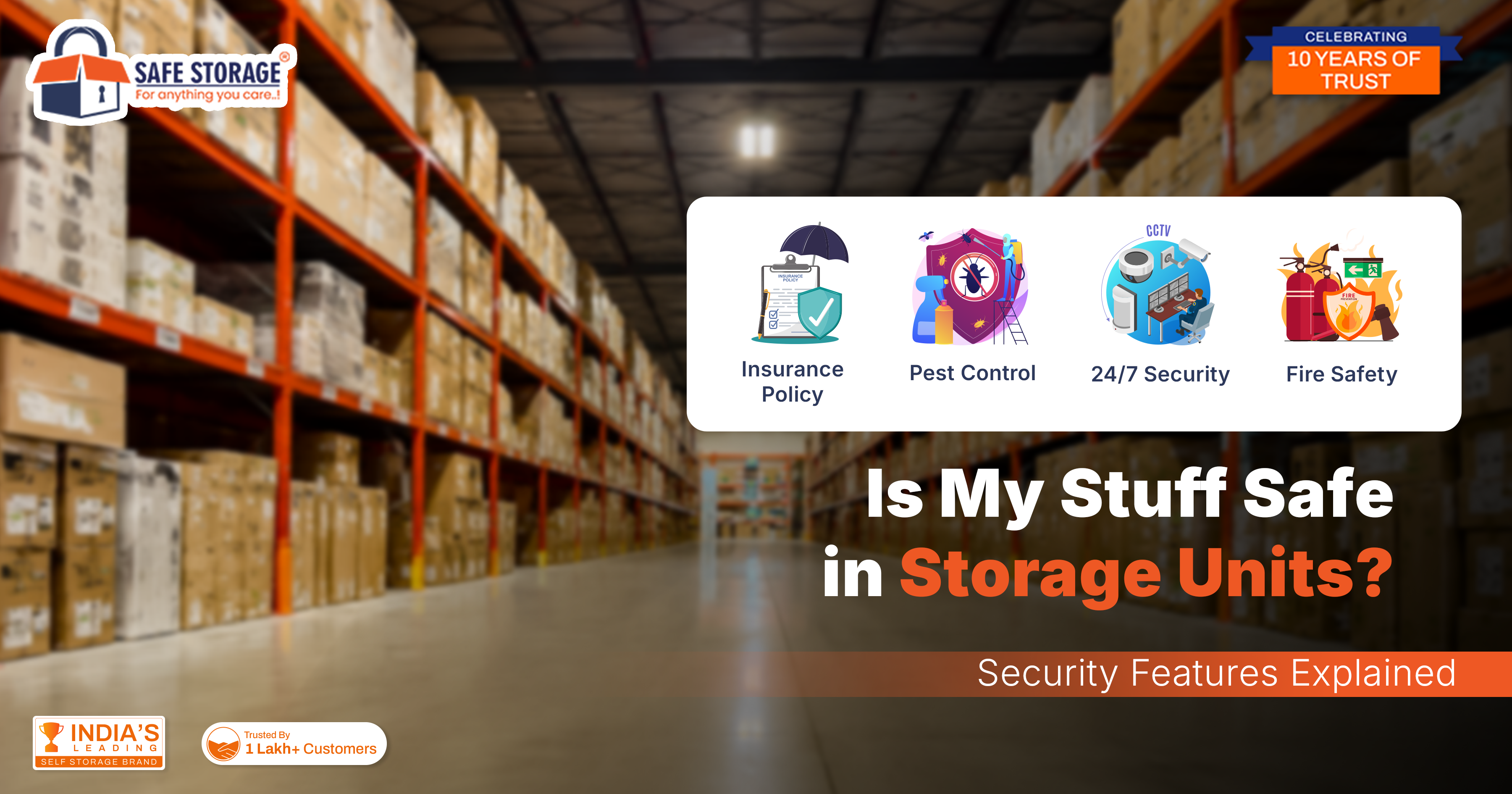
Is My Stuff Safe in Storage Units? Security Features Explained
If you have never used a self-storage unit before, the very first question that comes to mind is the most honest one: will my belongings actually be safe once they leave my home? It is a fair concern. You are handing over furniture, appliances, documents, and sometimes irreplaceable personal items to a facility you may have only seen once. At SafeStorage, we have stored goods for thousands of families and businesses across Bangalore, Chennai, Hyderabad, Kolkata, Pune, Mumbai, Visakhapatnam, Coimbatore, and Dubai, and this is the question we answer every single day. This guide explains exactly what keeps your stuff safe in a modern storage unit, and what you should look for before you trust any provider with your belongings.
The Short Answer
Yes, your belongings are safe in a professionally run storage unit, provided the facility is built and operated to genuine security standards. The safety of your goods does not come from a single lock on a door. It comes from layers: physical barriers, surveillance, controlled access, fire protection, environmental control, insurance, and trained people. When all of these work together, a storage unit is often safer than keeping the same goods at home or in an unattended flat. The risk lies entirely in choosing the wrong provider, which is why understanding the security features below matters so much.
The Layers of Storage Security That Actually Protect Your Goods
1. Physical Security and Perimeter Protection
The first line of defence is the building itself. A serious storage facility is housed in a secure, dedicated warehouse rather than an open shed or a residential garage. Look for boundary fencing, a single controlled entry point, and solid construction. At SafeStorage, goods are stored in enclosed warehouse facilities rather than left in open yards, which protects against weather, pests, and unauthorised entry alike.
2. CCTV Surveillance
Round-the-clock CCTV coverage is non-negotiable. Cameras at entry and exit points, along storage aisles, and at loading bays create a continuous visual record. The value of CCTV is twofold: it deters opportunistic theft, and it provides evidence if anything is ever disputed. When you visit a facility, ask where the cameras are, how long footage is retained, and who can access it.
3. Access Control
Who can walk into the storage area, and how is that controlled? In a well-run facility, the general public cannot wander among the stored goods. Access is restricted to authorised staff, and your items are tracked against your specific account and order. This controlled-access model is one of the biggest differences between professional storage and simply renting an empty room somewhere.
4. Inventory Tracking and Tagging
Security is not only about keeping intruders out. It is also about knowing exactly what you stored and being able to return every single item. Each item or package should be catalogued, tagged, and logged against your account when it is picked up. A documented inventory means that when you ask for your goods back, nothing is guessed at and nothing goes missing in the shuffle.
5. Fire Safety
Fire is one of the most serious threats to stored goods, and it is often overlooked by customers focused only on theft. Ask whether the facility has smoke detection, fire extinguishers, and clear fire-safety protocols. A responsible operator treats fire readiness as seriously as it treats locks and cameras.
6. Protection From Damp, Dust and Pests
In Indian conditions, the quiet enemies of stored goods are humidity, dust, and pests rather than burglars. Monsoon damp can warp wood and grow mould; dust ruins upholstery; rodents and insects destroy fabric and paper. Good storage means clean, dry, well-maintained warehouse space, proper wrapping of furniture, and pest-management practices. This is why how your goods are packed and where they are stored matters as much as the alarm system.
7. Insurance and Transit Cover
Even the best security cannot promise that nothing will ever go wrong, which is why insurance is the final safety net. Reputable storage providers offer transit and storage insurance so that, in the rare event of damage or loss, you are financially protected. Always ask what cover is available, what it includes, and how a claim would work. A provider that talks openly about insurance is a provider that takes responsibility for your goods.
8. Trained People and Accountability
Technology is only as good as the people operating it. Trained packing teams handle your goods correctly, supervisors maintain the inventory, and a clear point of contact gives you accountability throughout. The human layer ties every other security feature together.
Storage Unit vs. Keeping Goods at Home
Many people assume their belongings are safest at home, but consider the reality. An empty flat during a relocation, a house under renovation, or a property left between tenants is far more exposed than a monitored warehouse. There are no cameras, no controlled access, no fire protocols, and no insurance on goods sitting in an unattended home. A professional storage unit replaces all of those gaps with managed, documented protection. For most relocation, renovation, and downsizing situations, supervised storage is the safer choice, not the riskier one.
How to Judge Whether a Storage Provider Is Genuinely Safe
Before you commit, run through this practical checklist. The answers reveal very quickly whether a provider takes security seriously:
1. Is the storage in a dedicated, enclosed warehouse rather than an open or shared space?
2. Is there CCTV coverage, and how long is footage kept?
3. Is access to the storage area controlled and restricted to authorised staff?
4. Is every item catalogued and tagged against your account?
5. Are there fire-safety measures in place?
6. How are goods protected from damp, dust, and pests?
7. Is insurance available for both transit and storage?
8. Will you get a clear point of contact and a documented agreement?
If a provider hesitates on any of these, treat it as a warning sign. A confident, transparent answer to each question is exactly what you should expect from a professional operator.
Our View at SafeStorage
In our experience, the customers who worry most before storing are the ones who are most reassured afterwards, because they finally see how much structure sits behind the word “storage.” Safety is not a slogan; it is a system of overlapping protections, and no single feature carries it alone. A camera without controlled access is incomplete. Controlled access without insurance leaves a gap. Insurance without good packing and a clean, dry warehouse simply means you are compensated for damage that should never have happened. Real safety comes from getting all of these right, together, every time. That is the standard we hold ourselves to, and it is the standard you should demand from anyone you trust with your belongings.
Common Mistakes People Make When Storing Their Belongings
Even when the facility is secure, the way goods are handed over can create avoidable risk. The most common mistake is choosing a provider on price alone, without asking a single question about how goods are stored or protected. The second is poor packing: items dumped loosely into a unit are far more likely to be scratched, crushed, or damp-damaged than items that are wrapped, padded, and stacked correctly. A third mistake is keeping no record of what was stored, which makes it impossible to verify that everything came back. The fourth is skipping insurance to save a small amount, only to regret it if something rare goes wrong. Avoiding these four mistakes does more for the safety of your goods than almost anything else, and a professional provider will guide you through each of them before your items ever leave your home.
What Happens to Your Goods Day to Day in Storage
Customers often imagine their belongings sitting alone in a sealed box, untouched and unwatched. In a managed facility, the reality is more reassuring. Goods arrive, are checked against the inventory, wrapped where needed, and placed in their designated warehouse space. Surveillance runs continuously, staff move through the facility during working hours, and the building is secured outside them. Nothing is left to chance and nothing is left unsupervised. When you request your items back, the same inventory that logged them in is used to bring them out, item by item, so that what you stored is exactly what you receive. This quiet, repeatable routine is what genuine storage security actually looks like in practice.
Frequently Asked Questions
1. Is my stuff really safe in a storage unit?
Yes, provided the facility is professionally run with proper physical security, CCTV, controlled access, fire safety, and insurance. With those layers in place, stored goods are usually safer than belongings left in an empty home during a move or renovation.
2. What security features should a good storage facility have?
Look for an enclosed warehouse, round-the-clock CCTV, controlled access restricted to authorised staff, item-level inventory tracking, fire-safety measures, protection from damp and pests, and transit and storage insurance. These features work together rather than in isolation.
3. Can anyone access my stored belongings?
In a well-run facility, no. The storage area is not open to the public; access is restricted to authorised staff, and your goods are tracked against your specific account and order so that only your items are released to you.
4. Are my goods protected against fire?
A responsible operator maintains smoke detection, fire extinguishers, and clear fire-safety protocols. Always ask a provider directly about their fire readiness, as it is one of the most serious and most overlooked risks to stored goods.
5. How are my belongings protected from humidity, dust and pests?
In Indian conditions, damp, dust, and pests are bigger threats than theft. Protection comes from clean, dry, well-maintained warehouse space, proper wrapping of furniture, and ongoing pest-management practices.
6. Is my stuff insured while in storage?
Reputable providers offer transit and storage insurance. Always confirm what cover is available, what it includes, and how a claim would be handled before you store. A provider that discusses insurance openly is one that takes responsibility for your goods.
7. Is storage safer than keeping things at home during a move?
Usually, yes. An empty flat or a house under renovation has no cameras, no controlled access, no fire protocols, and no insurance on the goods inside. A monitored warehouse replaces all of those gaps with managed, documented protection.
8. How do I know nothing will go missing?
Item-level inventory tracking is the answer. Each item should be catalogued and tagged against your account when it is picked up, and the same record is used to return everything, so nothing is guessed at and nothing is lost in the shuffle.
9. What is the biggest mistake people make when storing goods?
Choosing a provider on price alone, without asking how goods are stored and protected. Poor packing, no inventory record, and skipping insurance are the other common mistakes that create avoidable risk.
10. How can I check whether a storage provider is genuinely safe?
Run through a simple checklist: enclosed warehouse, CCTV with footage retention, controlled access, item tagging, fire safety, damp and pest protection, insurance, and a clear point of contact with a documented agreement. Confident, transparent answers signal a professional operator.
Final Thoughts
So, is your stuff safe in a storage unit? With the right provider, yes, and often safer than it would be anywhere else during a move or renovation. The key is to look past the price and ask about the layers of security that actually protect your goods: physical security, surveillance, access control, inventory tracking, fire safety, environmental protection, and insurance. When those layers are in place and operated by trained people, you can hand over your belongings with genuine peace of mind. The honest test of any storage provider is simple: do they treat your belongings with the same care you would? At SafeStorage, that is the standard we work to every day, across every city we operate in. If you would like to see how we protect your goods at every stage, our team is ready to walk you through it.
Store With Confidence
Your belongings deserve more than a locked room and a hope that nothing goes wrong. They deserve a managed, monitored, fully accountable system built to keep them safe from the moment they leave your home to the moment they return. That is exactly what SafeStorage delivers across every city we operate in. Whether you are moving, renovating, downsizing, or simply need space, let us show you how secure storage should feel.
Call 8088848484 | Visit safestorage.in
.png)
💬 Comments
Leave a Comment