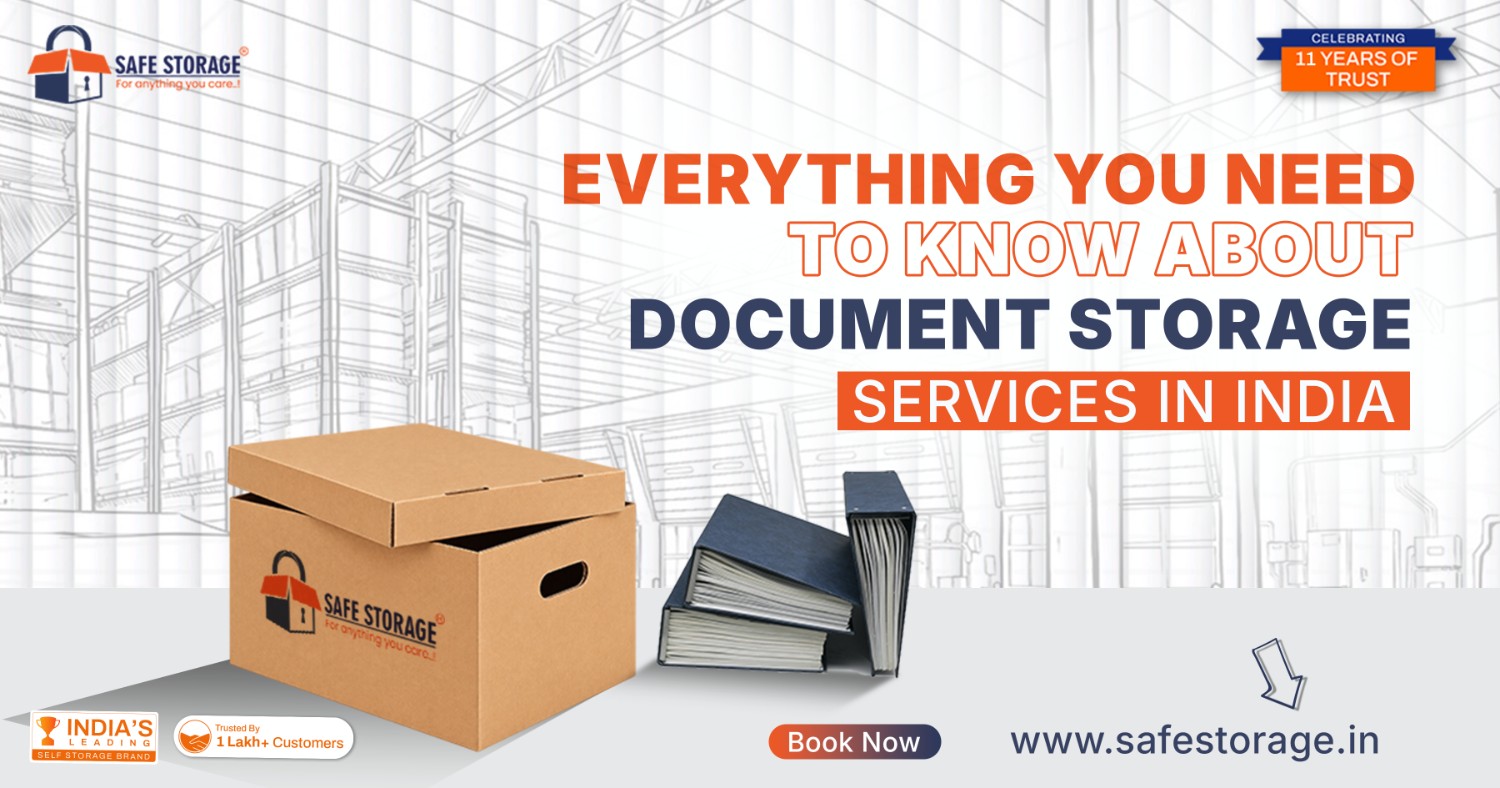
Everything You Need to Know About Document Storage Services in India
Ask almost any growing business in India what is quietly eating their office space, and the answer is the same: paper. Invoices. Contracts. GST records. HR files. Board minutes. Property papers. It piles up faster than anyone plans for, and much of it cannot simply be thrown away — the law says you have to keep it, sometimes for years. So a corner becomes a cupboard, the cupboard becomes a room, and one day finding a single file means sending someone to dig through boxes nobody has opened since the last audit. That is the exact problem document storage services solve. This guide covers what it is, how it works in India, who needs it, what it costs, and how to pick the right partner — so your records end up safe, organised and easy to get back.
What Document Storage Actually Is, and Why It Matters
Document storage means keeping your physical business records offsite, with a specialist who catalogues and protects them, instead of stacking boxes in a spare room of your own. Your files get boxed, barcoded, shelved in a monitored facility, and returned whenever you ask for them. In India this matters more than most businesses realise. Tax law, company law and a string of sector rules all require records to be held for set periods and produced on demand when an auditor or regulator comes calling. Store them badly and it is not just messy — it is a compliance risk waiting to surface at the worst possible moment.
Handled properly, it flips the whole thing on its head. You know what you have, where it sits, and how fast you can get it back. That move from chaos to control is really the entire point.
Who Actually Needs Document Storage in India
This is not just a big-corporation problem. Once records start stacking up, the need shows up almost everywhere.
1. Anyone with statutory record-keeping to do
Accounting records, GST filings, tax documents, statutory registers — all of it has to be kept for years. Finance teams, CA firms and auditors usually need shelves of files kept safe but rarely touched, which is exactly what offsite storage is built for.
2. Professional and regulated sectors
Law firms have case files and contracts. Clinics and hospitals have patient records. Banks and NBFCs have KYC and loan paperwork. These documents are confidential, legally serious, and have to be both locked down and quickly retrievable — a tough combination to manage in-house.
3. Companies simply running out of room
Office rent in Indian cities is not cheap, and using that space to warehouse old files is an expensive habit most businesses never stop to question. Shift the archive offsite and that floor space goes back to people and work.
4. Businesses in the middle of a change
Relocating, merging, downsizing, moving to hybrid — any of these can leave you with archives and nowhere to put them. Document storage covers that gap without anyone improvising with a garage or a stairwell.
How Document Storage Services Work
A good provider runs a tight process from the first box to the final retrieval. In practice it looks like this.
1. Pickup and inventory
Your documents are collected from your premises, boxed where needed, and logged. Every box gets a unique barcode so it can be tracked exactly — no guessing, no quietly missing files.
2. Secure storage
The boxes go into a monitored facility with controlled access, CCTV and protection from fire, dust and damp. Your archive lives somewhere built for it, not in an office corner under a leaking AC.
3. Indexing and tracking
Because each box is barcoded and catalogued, you always know what is stored and where. This is the bit that makes fast retrieval possible — the difference between a five-minute request and a lost afternoon.
4. Retrieval on demand
Need a file? You ask, it gets located and delivered. Audit, legal matter, or just day-to-day reference — the records stay genuinely accessible even though they are no longer under your roof.
The Real Benefits
Clearing space is the obvious win, but it is far from the only one. For most businesses the advantages keep compounding.
1. It frees up expensive office space
Filing cabinets and store rooms quietly soak up some of your most expensive real estate. Move the archive offsite and that space goes back to work — and at storage rates from 99/month with zero deposit, it costs a fraction of what office space does.
2. Stronger security and confidentiality
Business records carry sensitive financial, legal and personal information. A monitored facility with 24/7 CCTV, biometric access and controlled handling protects that far better than an office cupboard with a key everyone has a copy of.
3. Audits stop being a scramble
When records are indexed and retrievable, statutory requests and audits become routine instead of stressful. You produce the right document quickly, stay compliant, and keep your blood pressure down when the auditor calls.
4. Protection from loss and damage
Fire, water, pests and plain misplacement destroy more business records than anyone likes to admit. Purpose-built storage with proper environmental protection cuts that risk sharply.
5. Faster, organised retrieval
Barcode tracking means files turn up in minutes, not hours. No more sending staff to rummage through boxes — you request, it is found, it is delivered.
6. Flexible and easy on the budget
With zero deposit and zero lock-in, you store what you need for as long as you need. Scale up in a busy stretch, scale back after, and never pay for empty space.
What to Look for in a Provider
Documents need more care than ordinary goods, and not all storage is equal. Weigh these before you commit.
1. Security infrastructure
24/7 CCTV, biometric or controlled access, and protection from fire and damp should be standard. Your provider needs to take confidentiality as seriously as you do.
2. Tracking and retrieval
Barcode-level tracking is non-negotiable. Without it, retrieval drags and things go missing. Ask exactly how documents are catalogued and how fast they come back.
3. Pickup and delivery
Doorstep pickup and delivery spare you the job of shuttling sensitive records around yourself. A provider that handles collection and return end to end is simply far easier to live with.
4. Flexibility and honest pricing
Zero deposit, zero lock-in and clear monthly rates let you store on your own terms. Steer clear of hidden charges and rigid long contracts.
5. Track record and reach
A provider working across many cities, with a big customer base and strong ratings, gives you consistency you can rely on. SafeStorage serves 1 lakh+ customers across 16+ cities, with a 4.9-star rating and over 3M+ sq ft of secure space.
Frequently Asked Questions
1. What is document storage?
It is the secure, organised offsite storage of physical business records by a specialist. Your files are boxed, barcoded, catalogued and kept in a monitored facility, then retrieved and delivered whenever you need them.
2. How long do businesses in India need to keep records?
It varies by record type and the law that applies — many tax, GST, accounting and company records must be held for several years, often six to eight or more. Because the periods differ, confirm the exact requirement for your records with your auditor or legal advisor.
3. Is offsite document storage safe and confidential?
Yes, with a professional provider. At SafeStorage, documents sit in facilities with 24/7 CCTV, biometric access and controlled handling, and every box is barcode-tracked from pickup to retrieval — secure and confidential throughout.
4. How quickly can I get a stored document back?
Fast, because every box is barcoded and indexed. You request the file, it is located and delivered, so your records stay accessible even though they are stored offsite.
5. How much does document storage cost in India?
SafeStorage plans start from 99/month with zero deposit and zero lock-in, so you only pay for the space and time you actually use — far cheaper than handing expensive office space over to old files.
6. Do I have to sign a long contract?
No. SafeStorage runs on zero lock-in and flexible monthly terms, so you can store for a few months or several years and scale up or down as things change.
7. Are my documents protected against fire and damage?
Professional storage uses purpose-built facilities designed to guard against fire, dust, damp and pests — risks an ordinary office cupboard cannot. That sharply lowers the chance of losing important records.
8. Can SafeStorage pick up and deliver my documents?
Yes, across 16+ cities. You do not move sensitive records yourself — trained staff handle collection, storage and return, with full tracking the whole way.
9. What kinds of documents can I store?
Almost any physical business record — invoices, contracts, GST and tax files, HR records, legal papers, registers and archives. If it needs to be kept securely and retrievable, it can be stored.
10. How do I get started?
Call 8088848484 or visit safestorage.in. The team helps you arrange pickup, set up barcode tracking, and pick a plan that matches how much you need to store.
Final Thoughts
Paper is not disappearing any time soon, and in India the duty to keep it safe and retrievable is only growing heavier. The businesses that handle this well are not the ones with the biggest filing rooms — they are the ones that moved their archives into secure, organised, properly managed storage and got on with the actual work. Document storage has quietly stopped being a nice-to-have. It is just sensible business hygiene now.
If your records are eating your office space, slowing your audits, or sitting somewhere you would rather not think about, it is worth fixing properly. Barcode tracking, 24/7 monitored facilities, doorstep pickup and delivery, zero deposit and zero lock-in — backed by 1 lakh+ customers across 16+ cities and a 4.9-star rating — is what makes secure document storage simple with SafeStorage.
Secure your business documents today. Call 8088848484 | Visit safestorage.in


💬 Comments
Leave a Comment