
How to Pack an Entire House Without Stress: Complete Packing Guide for a Smooth Move
Nobody panics about moving house. People panic about packing it. The truck is booked, the new keys are coming, and then you open the kitchen cupboard and realise a home holds roughly ten times more than you thought, and every piece of it needs to be wrapped, boxed and carried without breaking.
Our pickup teams at SafeStorage walk into homes mid-pack every single day, and we can tell within a minute how the move will go. The stressed homes all share the same tells: packing started three days too late, boxes have no labels, and the tape ran out on Sunday night. The calm homes share a system. This guide is that system, room by room, from the first checklist to the last lock, so your move runs on plan rather than adrenaline. None of it is complicated; all of it is easier when someone tells you the order.
Plan Before You Pack
Packing is a project, and projects run on timelines. Work backwards from moving day: three weeks out, book your movers, because good crews and month-end dates disappear fast, and prices climb for latecomers. Two weeks out, declutter. Every item you sell, donate or discard is an item you don't pack, don't pay to transport and don't find a place for later; most households can shed a fifth of their belongings without missing anything.
Ten days out, start packing the rooms you use least, the store room, the bookshelf, the festival crockery. Write a one-page checklist covering utility disconnections, address updates and school records, and stick it on the fridge where the whole family answers to it. A packing schedule of one room every day or two feels almost lazy, and that's the point: the families who pack calmly are simply the ones who started early. If you take only one single thing away from this whole guide, let it be the calendar.
Packing Supplies Checklist
Buy more than you think you need; leftover supplies are returnable, but a supply run on packing night is misery. For a 2BHK, expect to use 30 to 50 boxes in mixed sizes. Small boxes for books and heavy items, medium for most things, large only for light, bulky stuff like bedding and cushions. A useful test: if you can't lift a packed box comfortably yourself, it's packed wrong, whatever its size.
1. Sturdy cardboard boxes in at least three sizes, double-walled for anything heavy
2. Bubble wrap for glass, ceramics and electronics, and packing paper for everything else; newspaper works but ink transfers onto light surfaces
3. Good packing tape, at least twice as many rolls as feels reasonable, plus a tape dispenser that will save your thumbs
4. Thick markers and coloured labels, one colour per room if you want the unpacking to feel effortless
5. Furniture covers or old cotton bedsheets for sofas, mattresses and wooden surfaces
6. Stretch wrap for keeping drawers shut, bundling bed slats and holding covers in place
7. Zip-lock bags for screws, remotes, cables and every small thing that vanishes during moves
Room-by-Room Packing Guide
1. Living Room
Start with decor and books, the things you won't miss for two weeks. The TV deserves its original box if you kept it; if not, wrap the screen in a blanket, bubble-wrap the corners, and mark the box with arrows and the word FRAGILE on every side. Photograph the cable setup behind the TV before unplugging anything; that one photo saves an hour of guesswork later. Remove sofa cushions and pack them in large boxes or bags, then cover the frame in cotton sheets held with stretch wrap, never bare plastic against leather, which traps moisture and marks the finish. Small decor and photo frames travel best wrapped individually and packed upright in a single well-marked box.
2. Kitchen
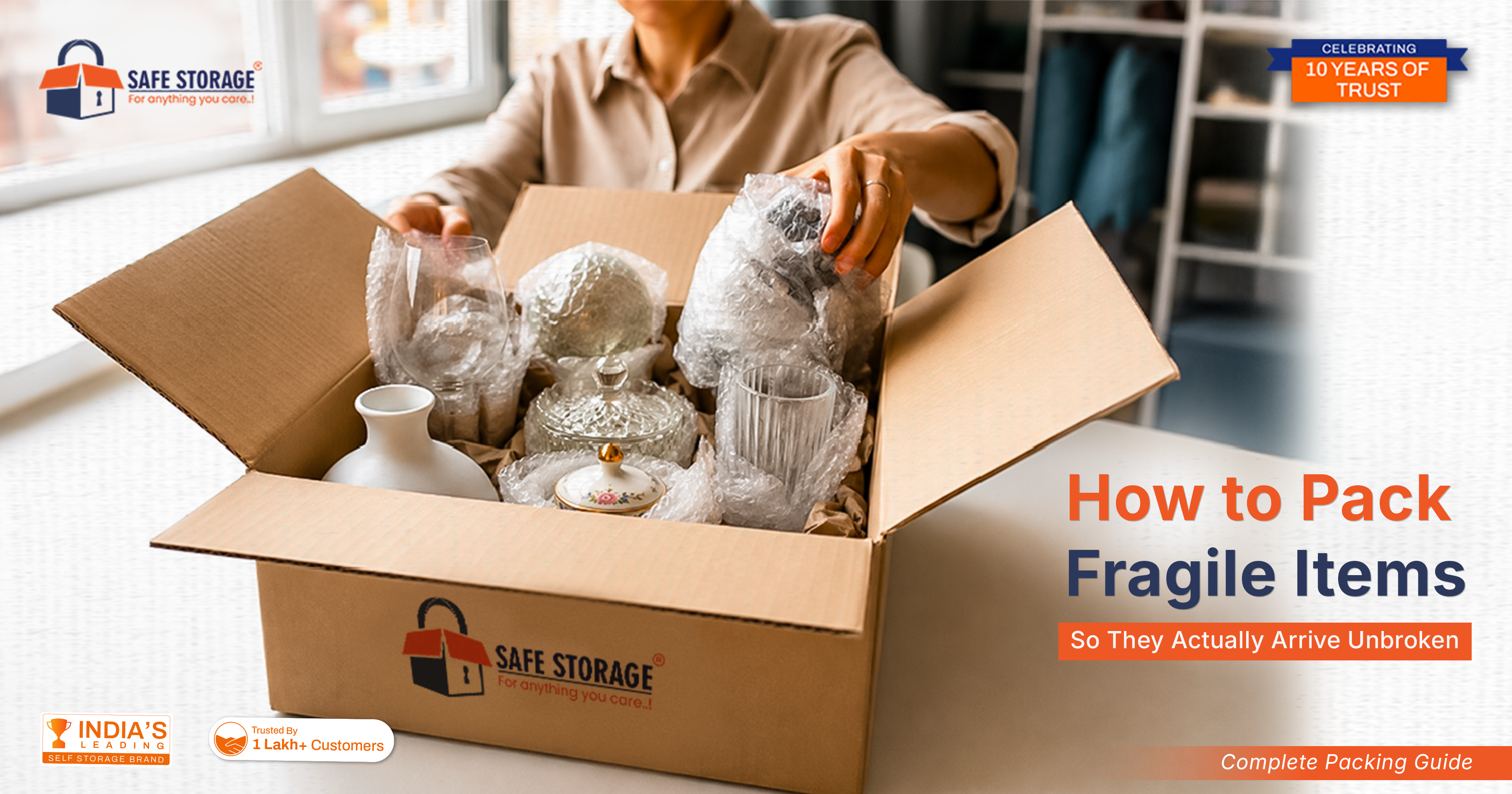
The kitchen takes longer than any other room, usually double what people budget, so start it early and finish it last: keep one plate, one cup and one pan per person out until the final morning. Stack plates vertically like records with paper between them; they survive far better on edge than flat. Wrap each glass individually and fill hollow spaces with crumpled paper, because a box that rattles is a box that breaks. Appliances should be clean and bone dry, the fridge defrosted a full day ahead, the washing machine drum secured, and mixer blades wrapped separately where fingers won't find them. Groceries deserve a decision too: use up what you can in the final fortnight and give away what you can't, because loose atta and oil bottles are the truck's least reliable passengers.
3. Bedroom
Clothes are the easy win: leave them on hangers and slide garbage bags over batches of ten, or fold straight into suitcases you own anyway. The mattress goes into a proper mattress cover, not loose plastic sheeting, and travels on its side. Dismantle the bed if it comes apart, tape the screws in a labelled zip-lock bag to the frame itself, and photograph the joints before you loosen the first bolt. Wardrobe contents go into medium boxes; the wardrobe itself gets its drawers emptied, doors stretch-wrapped shut and corners padded. Small valuables from the bedroom never enter a carton at all; they travel on your person.
4. Bathroom
Ruthless is the word. Half-used bottles leak, so bin anything below a third full and tape the caps of everything that survives, then bag each item; one shampoo leak can perfume an entire box of towels. Medicines travel with you, not the truck, in a clearly marked pouch along with first aid basics and any prescriptions the family runs on, because moving day produces cuts, headaches and misplaced strips exactly on schedule.
5. Home Office
The laptop and its charger stay in your personal backpack, full stop. Documents, certificates, property papers, passports, go in one file that never leaves your sight. Back up computers before the move, then pack monitors and desktops like TVs: padded, upright, labelled. Coil each cable separately, bag it, and label the bag with the device it belongs to; future you, sitting in the new house at 10 pm, will be grateful.
Packing Tips That Actually Reduce Stress
One room at a time, always. Finishing the bedroom completely beats half-finishing three rooms, because progress you can see keeps morale alive. Label every box on the top and one side with the room and a line of contents, and number them so you know 32 of 34 arrived. Pack a first-night essentials box per person: a change of clothes, chargers, toiletries, medicines, a towel, the kettle and some tea, so nobody unpacks cartons at midnight looking for a toothbrush. Spend properly on tape and boxes; the entire supplies bill is usually less than the cost of one broken television. And photograph everything electronic before disconnecting it, every cable, every port. Our crews have watched customers reassemble entire entertainment units from four phone photos, and watched others spend a weekend on it without them.
Common Packing Mistakes to Avoid
After thousands of pickups, the same five mistakes account for most moving-day disasters. Starting too late is the parent of all of them; packing a full house in two days produces unlabelled boxes and broken glassware by design. Overloading is next: a large box packed solid with books tears at the bottom on the staircase, which is exactly where you don't want a library landing. Mixing heavy and fragile in one box means the pressure cooker wins and the dinner set loses. Skipping labels feels fine on packing day and turns unpacking into archaeology. And forgetting the essentials bag guarantees the worst first night, with the whole family hunting through forty boxes for one phone charger. Every one of these is avoidable with a calendar and a marker pen.
How Self Storage Can Help During Your Move
Even a perfectly packed move can hit a gap. The new flat's possession slips by three weeks. You're moving into temporary accommodation while the house hunt finishes. A renovation must complete before the furniture arrives, or you simply want to shift in stages instead of one chaotic day. Some families also use a move as the trigger to declutter and store what they can't yet decide about, seasonal items, inherited furniture, the boxes marked someday.
This is exactly what self storage exists for. SafeStorage offers secure household and furniture storage with doorstep pickup, 24/7 CCTV, biometric access and barcode tracking on every item, in clean, pest-controlled facilities. Plans start at just Rs 99 with zero deposit and zero lock-in, so a three-week gap costs three weeks and nothing more. Over 1 lakh customers across 16+ cities have bridged their moves this way, and the 4.9-star rating reflects it.
Moving Day Checklist
1. Call the movers the evening before to confirm timing, truck size and the crew count
2. Keep documents, valuables and the essentials bags in your car or with a designated family member, never on the truck
3. Charge every phone and power bank overnight; moving day drains batteries and tempers alike
4. Walk every room after loading, opening every cupboard, every loft and the space behind every door
5. Switch off the geyser, gas and mains, take a photo of the electricity meter reading, and lock up
Ten quiet minutes of checking beats a return trip across the city for a forgotten loft box, and the meter photo quietly settles any dispute with the landlord before it starts.
Frequently Asked Questions
1. How early should I start packing?
Three weeks before moving day for a full house, ten days at absolute minimum. One room every day or two keeps it painless.
2. What should I pack first?
The rooms and items you use least: store rooms, books, decor, off-season clothes and festival crockery. Daily-use items go last.
3. What should I leave until the last day?
One plate, cup and pan per person, basic toiletries, chargers, that day's clothes, and cleaning supplies for the final wipe-down.
4. How do I pack fragile items?
Individually wrapped, packed tight so nothing rattles, plates on edge, hollow spaces filled with paper, and FRAGILE marked on every side of the box.
5. How many boxes do I need?
Roughly 30 to 50 for a 2BHK and 50 to 80 for a 3BHK, in mixed sizes. Buy extra; unused boxes return, midnight shortages don't.
6. Should I hire professional packers?
For a full household, usually yes; they finish in hours what takes families days. Pack valuables, documents and sentimental items yourself regardless.
7. Can I use self storage during moving?
Yes, and it's often the smartest part of the plan when dates don't align. SafeStorage picks up from your doorstep, with plans starting at just Rs 99,zero deposit and zero lock-in.
8. How can I reduce moving stress overall?
Start early, label everything, pack an essentials bag, and accept that one thing will still go wrong. With a system, it'll be a small, laughable thing instead of a crisis.
Final Thoughts
A stress-free move isn't luck; it's a three-week head start, a marker pen used religiously, and boxes that were packed with the unpacking in mind. Plan the timeline, declutter first, work one room at a time, and keep the essentials with you, and moving day becomes just a long day rather than a crisis. Moving to a new home? SafeStorage offers secure household storage, furniture storage and doorstep pickup to make the whole journey easier. Call 8088848484 or visit safestorage.in for a free quote today.
Moving Home? Store Your Belongings Safely with SafeStorage – Call 8088848484 | Visit safestorage.in


💬 Comments
Leave a Comment