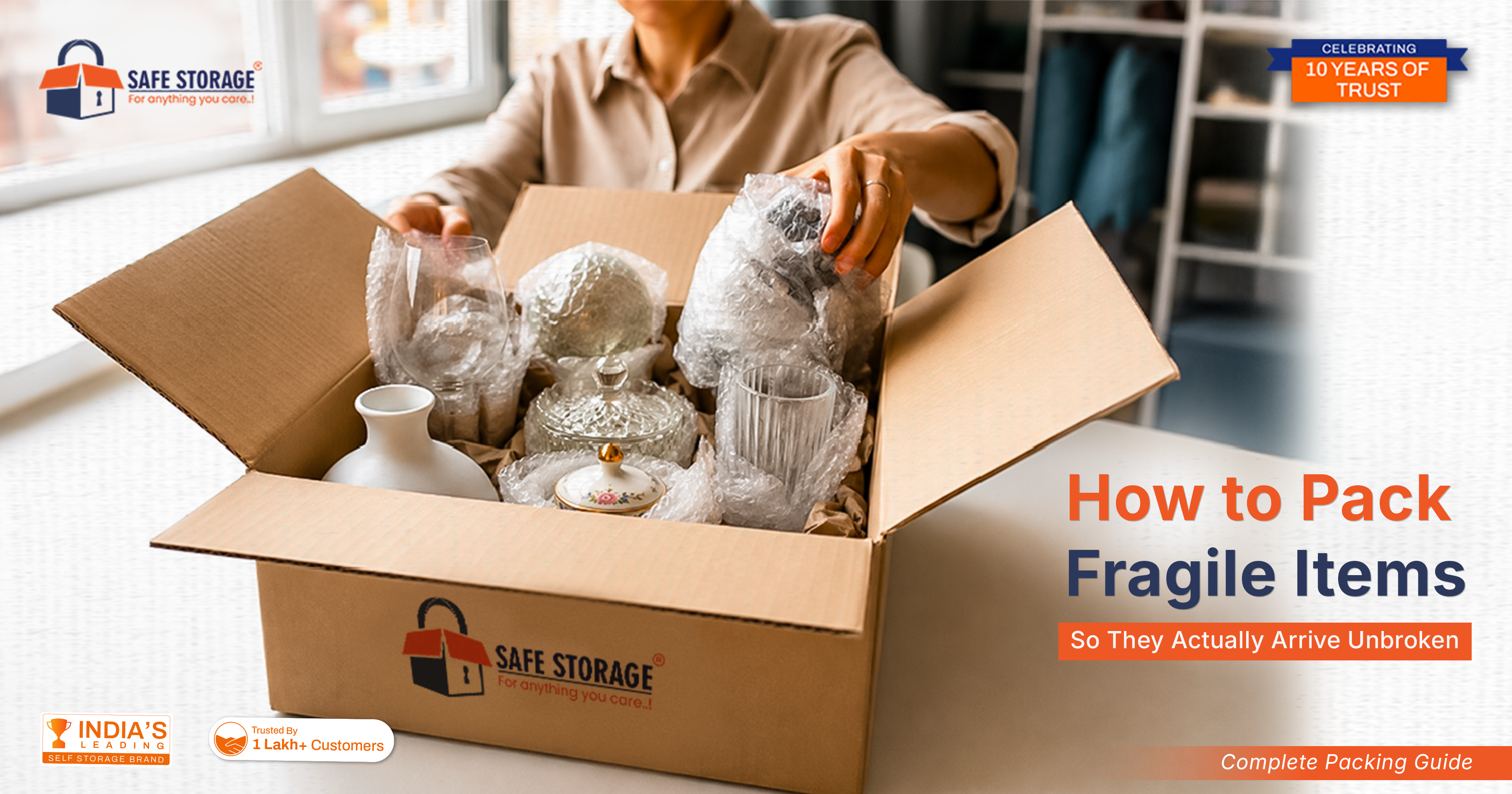
How to Pack Fragile Items So They Actually Arrive Unbroken: Complete Packing Guide
Every mover has heard the sound. The truck stops suddenly, a box shifts somewhere, and something inside makes the noise that only breaking glass makes. The strange part is that fragile items rarely break because a move was rough; they break because the packing assumed it would be gentle. Trucks brake hard, boxes get stacked, and a wine glass wrapped in one hopeful, optimistic layer of old newspaper never really stood a chance against a speed breaker.
Our teams at SafeStorage handle fragile household items every day, and the difference between a dinner set that arrives whole and one that arrives as a jigsaw puzzle almost always comes down to about fifteen minutes of learnable technique per box. This guide covers exactly that technique: the supplies that matter, the item-by-item method professionals use, and the labelling that keeps careful packing careful all the way to the last staircase.
Internal link: House Relocation Guide → link to your complete house shifting / relocation guide
Why Fragile Items Get Damaged During Moving
Breakage has five parents, and they usually work together. Weak, reused boxes collapse under stacking; a carton that carried groceries was never built to carry a crockery set. Insufficient cushioning lets items touch each other or the box walls, and glass touching glass in a moving truck is a countdown. Overloaded cartons tear at the base or get dropped simply because they're too heavy to grip properly.
Then comes handling: a box with no markings gets treated like every other box, tipped on its side, stacked under the mixer-grinder, carried in a hurry. Which is the fifth parent, missing labels. Loaders aren't careless people; they are simply fast people working to a schedule, and an unmarked anonymous box gives them absolutely no reason to slow down for it. Good packing solves the first three problems; good labelling solves the last two.
Essential Packing Supplies Checklist
Fragile packing is one place where cheap materials cost the most. For an average 2BHK's breakables, stock up on:
1. Bubble wrap, the small-bubble kind for wrapping and large-bubble for cushioning layers
2. Packing paper or unprinted newsprint; ordinary newspaper works but its ink transfers onto light surfaces
3. Foam sheets for plates, glass shelves and anything with a flat delicate face
4. Double-walled corrugated boxes in small and medium sizes; fragile items never go in large boxes
5. Strong packing tape and a dispenser, plus stretch wrap for bundling and securing covers
6. Corner protectors for mirrors, frames and glass tabletops
7. FRAGILE and THIS SIDE UP stickers, thick markers and a notebook for your inventory
Internal link: Packing & Moving Guide → link to your complete house packing guide
Step-by-Step: How to Pack Each Fragile Item
1. Glassware
Wrap every single glass individually, with absolutely no exceptions, starting from a corner of the paper and tucking the ends into the mouth of the glass. Stemware gets its delicate stem wrapped separately first, because the stem always snaps well before the bowl ever cracks. Use cell dividers in the box if you can find them, stand glasses upright, never on their sides, and fill every gap with crumpled paper until nothing moves when you shake the box gently. If it rattles, it breaks.
2. Crockery and Plates
The single biggest trick in this guide: pack plates vertically, on their edges like vinyl records, never flat in a stack. A flat stack concentrates the entire pile's weight onto the bottom plate at every single bump; plates standing vertically share the load between them and survive. Slide a foam sheet or two layers of paper between each plate, cushion the box base with three inches of crumpled paper, and keep the total weight liftable with one hand under the box.
3. Mirrors and Picture Frames
Tape a large X across the glass face; it won't prevent a crack, but it holds the pieces together and stops a crack from travelling. Add corner protectors, wrap the whole frame in bubble wrap, and slide it into a flat picture box or between two cut cardboard sheets taped shut. Mirrors travel upright, standing on their edge, never lying flat, and get loaded between two soft, stable items like mattresses.
4. TVs and Monitors
The original box with its foam inserts is gold; if you kept it, use it. If not, wrap the screen in a soft blanket, add a foam or cardboard sheet over the panel, bubble-wrap the whole unit, and mark the screen side clearly. Photograph the cable connections before unplugging, and never lay a flat-screen face down or flat on its back; panels are built to be vertical and crack under their own weight when they aren't.
5. Laptops and Small Electronics
Laptops travel in your own backpack, not the truck. For other electronics, use anti-static bubble wrap where you can, remove batteries from remotes and devices to prevent leaks, and pack each cable coiled and bagged with a label naming its device. Original boxes first, then small sturdy cartons padded on all six sides.
6. Decorative Items and Showpieces
The odd and awkward shapes are the real ambush here. Wrap each piece in paper, then bubble wrap, and treat protruding parts, handles, spouts, figurine arms, to an extra layer of their own since they snap first. Nest small items in a padded box and fill every empty space; hollow space is where décor goes to die. Sentimental irreplaceables, the wedding gift, the grandmother's vase, ride with you in the car, never on the truck.
7. Lamps and Light Fixtures
Disassemble everything that comes apart: shade off, bulb out, harp separated. Wrap the base and shade as two separate packages, because a shade crushed by its own base is the most preventable break in moving. Bulbs travel in their original sleeves or a small, clearly marked padded box, and chandeliers or delicate fixtures deserve professional crating, which costs less than the fixture did.
How to Label and Organize Fragile Boxes
Packing well and labelling badly is half a job. Every fragile box gets a bold FRAGILE sticker on all four sides plus the top, a THIS SIDE UP arrow, and the destination room written large. Number every box and keep a simple inventory list, box 12: kitchen, dinner set and glasses, on your phone or a notebook. On moving day the numbers tell you instantly that all 14 fragile boxes arrived, and the room names keep the crockery out of the bedroom pile at the destination. The whole discipline costs thirty seconds per box and saves hours, sometimes heirlooms, at the other end.
Common Packing Mistakes to Avoid
The same errors break the same items every season. Reusing weak grocery boxes for heavy breakables. Mixing the pressure cooker into the crockery box, where the heaviest item always wins. Leaving empty spaces, so items travel inside their own box with every turn. Overpacking until the carton weighs 25 kilos and gets dropped at the first landing. And skipping labels, which converts all the careful wrapping into just another anonymous box under three others. One more from our crews: taping the box before the shake test. Close it, shake gently, and if anything moves or clinks, open it and add paper. That five-second shake test catches tomorrow's breakage today, and our crews run it on every single fragile box they pack.
How Self Storage Protects Fragile Items
Sometimes the safest place for your breakables is out of the chaos entirely. If there's a gap between homes, a renovation underway, or a move happening in stages, storing fragile boxes keeps them away from the two most dangerous places they can be: a construction zone and a hallway where things get shifted daily.
SafeStorage facilities are clean, dry, pest-controlled and dust-free, with 24/7 CCTV, biometric access and barcode tracking on every item, so your glassware sits exactly where it was placed, untouched, until you're ready. Plans start at just Rs 99 with zero deposit and zero lock-in, so fragile items can wait a week or a year on your schedule. Over 1 lakh customers across 16+ cities have trusted us with everything from dinner sets to inherited china, and the 4.9-star rating includes a lot of unbroken heirlooms.
Internal link: Self Storage, Temporary Storage and Storage Pricing → link all three pages here
Moving Day Tips for Fragile Items
Always load the fragile boxes last so they come off the truck first, and tell the crew which boxes they are; a spoken word reinforces every sticker. Keep them upright and on top of the stack, never under anything, and wedge them so they can't slide, with mirrors and frames standing between mattresses. At the new home, unload fragile boxes to one designated corner away from the traffic, and open them within a day or two: transit damage claims have time limits, and finding a crack on day one is a very different and far easier conversation than discovering it in month two.
Frequently Asked Questions
1. What is the safest way to pack glassware?
Wrap each glass individually in packing paper, stand them upright in a divided or well-padded small box, and fill every gap until nothing moves in a gentle shake.
2. How do I pack mirrors without breaking them?
Tape an X across the glass, add corner protectors, bubble-wrap the frame, box it flat between cardboard sheets, and always transport it standing on its edge.
3. Should I use bubble wrap or packing paper?
Both, in layers: paper against the item to prevent scratches and ink marks, bubble wrap over it for impact protection. Paper alone cushions too little; bubble wrap alone can trap moisture against surfaces.
4. How can I protect electronics during moving?
Original boxes first, anti-static wrap where possible, batteries out, screens padded and kept vertical, and every cable bagged and labelled. Laptops travel with you.
5. Can I store fragile items in self storage?
Yes, and it's often safer than a house mid-move. SafeStorage's clean, dust-free facilities with barcode tracking keep fragile boxes untouched until you need them.
6. How long can fragile items stay in storage?
As long as you like. With zero lock-in and plans starting at just Rs 99, a week and a year cost proportionally the same, and extension is a phone call.
7. Which boxes are best for fragile items?
Small and medium double-walled corrugated boxes, always new or near-new. Large boxes invite overpacking, and a heavy box is a dropped box.
8. How do professional movers pack delicate belongings?
Exactly as this guide describes, plus speed and habit: individual wrapping, vertical plates, upright mirrors, dense padding, the shake test, and labels on every face of the box.
Final Thoughts
Fragile items don't actually need luck; they need good paper, honest bubble wrap, small sturdy boxes and fifteen genuinely unhurried minutes per carton. Wrap individually, pack tight, keep plates vertical and mirrors upright, label loudly, and do the shake test before the tape gun wins. Need a safe place for your fragile belongings during the move? SafeStorage offers secure household storage, furniture storage and doorstep pickup to keep your valuables protected until you're ready to unpack. Call 8088848484 or visit safestorage.in for a free quote today.
Protect Your Fragile Belongings – Store Safely with SafeStorage – Call 8088848484 | Visit safestorage.in
.png)


💬 Comments
Leave a Comment