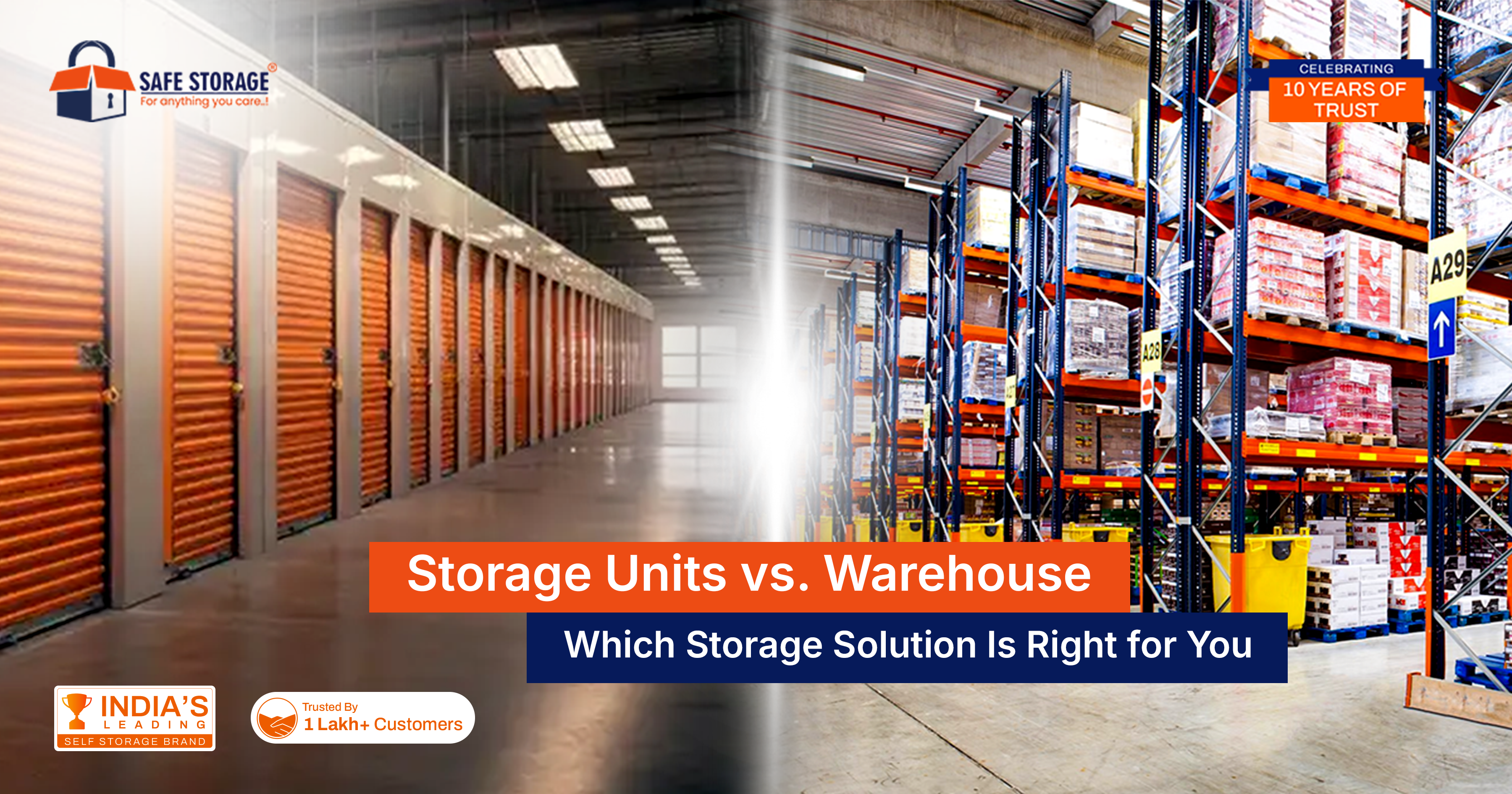
Storage Units vs. Warehouse: Which Storage Solution Is Right for You
With small houses and businesses now growing taller and faster, additional storage is fast becoming the norm across India. Whether moving homes, going abroad, managing excess stock, or running an online business, one big question comes up more often:
Storage units or Warehouse Storage?
At first glance, both seem the same. However, in reality, storage units and warehouse storage serve very different purposes. Wrongly choosing one over the other incurs higher costs, limited access, security concerns, and inefficient operations.
This detailed guide clears and educates you about everything you need to know to make your best storage choice.
Author
Written by: Karthik Ramanan
Karthik is a content strategist specialising in storage solutions, urban living, and relocation services in India. His focus is on simplifying wicked complex topics, assisted by practical, real-world insights.
Storage Units:
What Are Storage Units and How Do They Work?
Storage units are lockable and private spaces rented to individuals or businesses, where their belongings can be safely stored for either short or long periods of time.
Unlike a warehouse, a storage unit is meant for personal consumption and easier access. One selects the unit size, gets the items packed, transported, and stored in a space that only he/she can reach. Most households, students, and small businesses rely on such delivery rather than bulky storage.
Storage units typically charge for features like CCTV monitoring and controlled entry in addition to offering monthly billing flexibility. This means that they are apt for those who prefer managing their items without worrying about complex inventory systems, which are normal in warehouses.
Storage Units for Household Goods?
The most practical solution for storing household goods securely and efficiently is to rent a storage unit.
This creates an apartment designed to store furniture, appliances, clothes, kitchen items, books, and electronics in relatively unmarked areas. Each unit is private, so household items aren't mixed in with other items, making it less likely that breakage or loss will occur.
Compared to warehouse storage, storage units are considerably more organised, presentable, and protective for household belongings, which is why families move into storage units rather than warehouses during a move, renovation, or downsizing.
Do Storage Units Really Keep Items Safe Even in the Long-Term?
Really, as storage units are meant for long-term storage, they can be really safe if they are managed professionally.
There is surveillance all around, protection against fire, control access systems, and pest management, in addition to stable conditions that help prevent damage over prolonged periods.
Inventory movement is preferred in warehouse storage, whereas for personal storage for quite a long time, public storage is excellent in providing greater protection, security and fewer risks in handling. [Click Here For Storage Unit].
Cost of Storage Units in India Per Month?
The price of a storage unit in India varies depending on the size of the unit, the location, and the time period for which the unit is stored.
Smaller units designed for boxes and luggage are less expensive than larger units used for completely storing households. Most providers offer flexible monthly plans and discounts for longer durations.
When compared with warehouses, storage units are very reasonably affordable for individuals since there are no handling charges or long-term contracts involved in their use.
Storage Units for Home Shifting and Moving?
Home shifting could become quite hassle-free and easier with the use of storage units.
The most common use of storage units is when people need some space between move-out and move-in dates. For example, if a new house is not yet ready for somebody to move into, belongings would have to be kept safe until they are ready for the new house.
Home shifting doesn't work well using warehouse storage, with their limitation of access and moving goods in bulk. Storage units allow smooth, safe relocation with the added benefit of refurbishment or making the new property ready.
Warehouse:
What Warehouse Storage Is Used For
Warehouse storage is mainly dedicated to businesses that store their goods in bulk.
It supports supply chain operations holding raw materials, finished products, and inventory, which need to be distributed later.
Unlike storage units, personal storage units are not meant for warehouse facilities and are rather designed to address efficiency, logistics, and movement of goods rather than convenience or periodic access.
Is warehouse storage ideal for Business Inventory?
Warehouse storage is suitable for businesses storing bulk inventory or large quantities of products.
Manufacturers, wholesalers, and e-commerce companies use warehouses for storing goods adjacent to transport networks. Warehouses provide pallet storage, loading docks, and inventory systems, [Click Here For Warehouse Storage].
For small businesses or new startups with little inventory, storage units provide better alternatives for increased flexibility without incurring high operational expenses.
Warehouse Storage vs. Storage Units: Conspicuous Comparison?
The main difference between warehouse storage and storage units is mainly the scale and purpose.
While storage units are meant for personal and small business use, with easy access and flexible terms, warehouse-storage operates within a structured volumetric framework of commercial operations.
Choosing the wrong alternative may lead to unneeded outlays or ineffective transfers of goods or setting up households that pay the most significant amounts in this section—households typically benefit more from storage units than from storage facilities, for warehouses that have greater bulk needs.
Costs of Warehouse Storage in India?
Costs for warehouse storage depend on the space used, the duration, the kind of handling services the customer pays for, and, of course, the location.
It also has other charges for the manpower, loading, unloading contracts, and all that. Thus, it is the only way in which warehouse storage can be declared inexpensive for large quantities for long periods of time.
For most personal requirements, warehouse storage becomes expensive and constraining compared to storage units.
Long-Term Storage in Warehouses?
Long-term warehouse storage is ideal for businesses that keep slow-moving or seasonal inventory.
Thus, they make it possible for companies to manage big amounts efficiently as long as they control the inventory through tracking and contracts.
For anyone or any household requiring long-term storage, storage units are better than personal or household storage. Less complicated access, better protection of items, and fewer management requirements make simple access a much better option.
Expert Quote
"For households and individuals, storage units offer better control, safety, and flexibility. Warehouses are built for logistics, not personal storage needs." — Rohit Mehra, Storage & Logistics Consultant (India)
Customer Review
"Our entire home was stored during renovation in SafeStorage. Clean facility, professional packing, and zero damage. Personal items felt way too risky in a warehouse." — Ananya R., Bangalore.
Storage units are best for households, students, and small businesses.
Privacy, easy access, better safety, and flexible pricing are all space storage gears; therefore, the McDocking Warehouse is perfect for bulk business inventory and logistics needs.
FAQs: Storage Units vs. Warehouse Storage
1. Is a storage unit better than a warehouse for household items?
Yes. Storage units are private, clean, and easier to access. They were designed for furniture, appliances, and personal items, whereas warehouses operate with bulk business inventory and do not consider household safety or convenience.
2. Can I access my items anytime in a storage unit?
Most storage units allow scheduled or flexible access. The easy access of storage units is unlike warehouse storage, where access is limited, often requiring prior approval or involvement from the handling staff.
3. Are storage units safe for long-term storage in India?
Yes. A professional storage unit provides inbuilt features like CCTV surveillance, pest control, fire safety, and controlled entry. Hence, they can be counted on for long-term storage of household or personal items.
4. Why should one consider warehouse storage and not storage units?
Warehouse storage suits a business entity that deals with bulk inventory, pallets, or supply-chain-related jobs. The key factor would be if one moves a decent volume or is in need of logistics support.
5. Are storage units costly when compared to warehouses?
Usually, storage units are cheaper for the individual or family. But for warehouses, the extra cost would include labour support, handling, contracts, and minimum space requirements, which therefore run up the overall cost.
6. Can students use storage units?
Yes. Storage units are typically used by students to store luggage, books, electronic devices, and furniture during holidays between internships or relocations that last for a long time.
7. Is it good for warehousing and storage while house moving?
Clearly not. Warehouse use goes against household moving. Storage units fare better, as their infrastructure lends easy access, a smaller area, and safer handling of any important possessions.
8. Do storage units combine my items with others?
Not at all. Storage units are private and lockable. Your items are stored separately, reducing the risk of loss, damage, or mix-ups, which may happen in open warehouse settings.
9. How do I choose the right storage size?
SafeStorage providers help assess your item list and suggest a suitable unit size. This avoids paying for unused space, which is a common issue in warehouse storage.
10. Which option is better for small online sellers?
Storage units work best for those with small quantities of inventory. They offer flexibility, are inexpensive, and allow easy accessibility; in contrast, warehouses will involve contract signing and bulk volumes.
Conclusion: Storage Units vs. Warehouse
The choice between storage units vs warehouse storage depends entirely on what you are storing and how the storage will be used. [Here More Information].
Storage units are a smart option for homeowners, tenants, students, or small businesses. They offer private space, better safety, easy access, flexible monthly plans, and professional handling. Storage units are meant for personal belongings and small inventories, suitable for all house shifting, renovation, long-term household storage, and temporary space needs.
Warehouse storage is, on the other hand, best suited for large business concerns that carry bulk inventory. It focuses on logistics and movement and does not care for convenience or the handling of any individual item. For personal use, warehouses tend to appear more costly, with limited access and unnecessary complexity.

💬 Comments
Leave a Comment