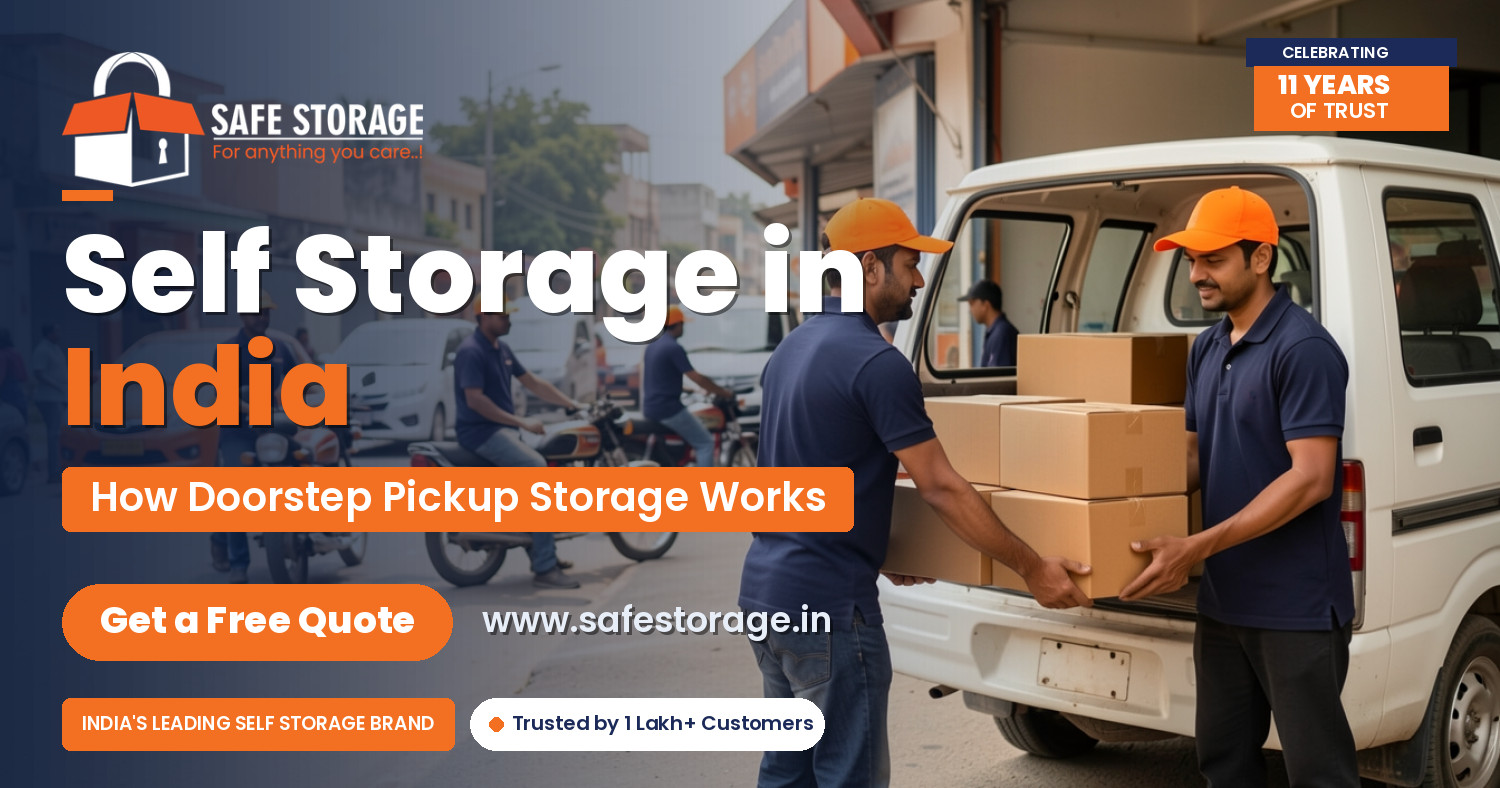
Self Storage in India: How Doorstep Pickup Storage Works
Searching for storage in India usually means one thing: you need space for your belongings without giving up a room in your own home. This page explains what the service actually covers, how SafeStorage's doorstep pickup process works, what it costs, and which cities we serve. It is written for renters moving between flats, families downsizing, and small businesses that have outgrown a cupboard, and it uses SafeStorage because we collect, insure and track every box ourselves rather than handing you a key and a unit number.
What Storage Means and Who It's For
With SafeStorage, storage is a service rather than a rented room you manage yourself. Instead of driving boxes to a facility and locking them in a unit, you book a pickup, our team packs and barcodes each item, and everything moves to a guarded warehouse. You never need to visit a location to drop off or arrange your own transport, and you never need to remember which shelf your winter blankets are on.
This model suits a wide range of situations. Renters moving between leases often need a gap of a few weeks or months where their furniture has nowhere to live; families downsizing to a smaller flat need somewhere for items they aren't ready to sell or discard; and people relocating to another city or country need their belongings held safely until they're settled. It also works well for anyone going through a home renovation, where furniture simply has to leave the house for the work to happen.
On the business side, small shops and e-commerce sellers frequently need somewhere for seasonal stock, display fixtures, or archived paperwork that doesn't need daily access but can't be thrown away. Students heading home for a long break, and professionals on a short posting abroad, use the same service for a much smaller volume of belongings.
How Our Service Works, Step by Step
The process is designed to remove the physical effort, not just the space problem, from the equation.
- Request a pickup slot that suits you, in your city, through our team.
- Our crew arrives with packing materials, wraps fragile and bulky items, and attaches a barcode to every box or piece of furniture individually.
- Your full inventory is logged against your account, so you can see exactly what has been collected and in what condition.
- Everything moves to a guarded, monitored warehouse rather than a self-access unit you'd need to visit yourself.
- When you need something back, you request a retrieval and we deliver it to your door, rather than you driving out to collect it.
Because every item is barcoded at pickup, you're never asking a warehouse team to "find the blue suitcase" by memory — the record already tells them where it sits and what condition it was in when it arrived. This also means partial retrievals are straightforward: you can ask for three boxes back without disturbing or re-sorting the rest of your inventory.
Most of this can be managed remotely. You don't need to be present for anything beyond the initial pickup, and updates on your inventory are available whenever you need to check what you still have.
Tracking What's in Your Plan
Once your items are collected, the barcoded inventory becomes the reference point for everything that follows. Instead of trying to remember whether the winter clothes went into box four or box seven, you can check the record directly and request exactly what you need back. This is especially useful for anyone storing for a long stretch, where memory of the original packing session has usually faded by the time a retrieval is needed.
It also removes a common source of disputes with traditional storage: disagreements about what was actually dropped off. Because the inventory is created at the point of pickup, not after, there's a shared record from day one rather than two different memories of what went into a van months earlier.
What It Costs and How Pricing Is Calculated
Pricing starts from Rs 99 per month, and the minimum period is 1 month. Your final price depends on how much you are storing and for how long, since you pay for the space your items occupy rather than booking a fixed-size unit upfront the way a traditional facility would ask you to.
| Household Size | Typical Items | Relative Space Needed |
|---|---|---|
| Studio / 1BHK | A few boxes, a mattress, small furniture | Small |
| 2BHK | Sofa, beds, appliances, boxes | Medium |
| 3BHK or larger | Full household, multiple appliances, furniture sets | Large |
| Business / seasonal stock | Inventory, equipment, documents | Varies by volume |
Because billing is based on actual space used rather than a fixed unit, a household moving a few boxes pays less than one moving an entire 3BHK, and nobody is paying for empty space in a unit sized for their largest possible future need. If your volume changes partway through — you retrieve some furniture, or add a few more boxes later — your plan adjusts rather than locking you into the original estimate.
There's no need to guess your space requirement precisely before booking either. Our team assesses what you're sending during pickup, so the plan reflects what you actually have rather than a rough guess made from your living room.
Short-term and long-term needs are handled the same way under the hood: a one-month gap between flats and a multi-year archive of business documents both run on the same pay-for-what-you-use model, just at different scales. There's no separate "short stay" product with worse terms attached — the minimum period is the only floor, and everything above that simply continues until you ask for items back.
Business Use: Seasonal Stock and Archives
Small retailers and e-commerce sellers tend to have a predictable spike in inventory around certain seasons, followed by months where that extra stock just takes up shelf space they'd rather use for something else. Rather than renting permanent extra floor space year-round, many move seasonal inventory into storage between peaks and bring it back only when it's needed again.
Offices and small businesses also use the same service for archived paperwork — tax records, old contracts, HR files — that needs to be kept for compliance reasons but rarely needs to be opened. Because everything is barcoded and logged, locating one specific file box later is a matter of checking the inventory record rather than searching through a storeroom shelf by shelf.
Security, Insurance and How Goods Are Protected
Every item placed into storage is insured and tracked from pickup to return. Warehouses are guarded and monitored, and because each box and piece of furniture carries its own barcode, there is a clear, auditable record of condition and location throughout the entire period your belongings are with us.
This matters most for the items people worry about losing track of — seasonal décor, important documents, or furniture that will sit untouched for months at a time. A barcoded inventory means you can check what you have without a physical visit, and insurance means a single mishap doesn't become a financial loss on top of an inconvenience.
Facilities are built around the same basic principles regardless of city: controlled access, monitoring, and a paper trail for every item that goes in and comes back out. That's a deliberate design choice, not an afterthought — the whole arrangement only works if people trust what happens to their belongings once they're out of sight.
Customers who want extra reassurance on a high-value item, like a piece of furniture passed down in the family or expensive electronics, can ask for condition notes to be recorded at pickup. That record then travels with the item, so if there's ever a question about its state, there's something concrete to check against rather than relying on memory alone.
Getting Ready for Your Pickup
A little preparation on your end makes the pickup itself faster and reduces the chance of anything being missed from your inventory.
- Group small items into boxes rather than leaving them loose — barcoding works per box, so loose items can be harder to track individually.
- Keep documents and valuables separate and flag them to the pickup team directly.
- Disassemble large furniture where you can, since it packs and transports more safely in parts.
- Make a rough list beforehand of what you expect to send, so you can cross-check it against the final inventory.
None of this is mandatory — the pickup team can pack most things on the spot — but a few minutes of sorting beforehand usually means a shorter visit and a cleaner inventory record afterwards.
What You Can and Cannot Store
Most household and business items are suitable, including:
- Furniture, mattresses and home appliances
- Boxed belongings, books and documents
- Seasonal items such as festive decorations or sporting equipment
- Business inventory, office equipment and archived files
- Vehicles' accessories, musical instruments and hobby equipment
Hazardous, flammable, perishable and illegal items cannot be accepted, in line with standard warehouse safety rules that apply across the industry, not just to us. This covers things like gas cylinders, loose chemicals, fresh food, and anything that could pose a fire or contamination risk to other customers' belongings in the same facility. If you're unsure whether something qualifies, it's worth asking before booking a pickup rather than after the crew arrives.
Items that sit in a grey area — a half-full paint tin, an old car battery, plants that need light and water — are usually easier to sort out with a quick question beforehand than to discover is a problem on pickup day. The general rule of thumb is simple: if it would be unsafe sitting next to someone else's furniture in a closed warehouse, it isn't something we can take.
Cities We Cover
SafeStorage currently operates across multiple Indian cities, with doorstep pickup available in each. In storage near me searches, Mumbai customers consistently find SafeStorage covering their neighbourhood, and the same holds for storage units near me queries across the city's different localities. We also serve storage in Delhi, with pickup slots built around the city's traffic patterns rather than a single fixed depot that everyone has to work around.
In the south and west, coverage extends to storage in Hyderabad and storage space in Pune, and our dedicated guide to storage space in Mumbai goes into more detail for businesses specifically, covering the kind of seasonal and inventory use cases shops run into.
Chennai, Noida and Gurgaon are also part of the network, each with the same doorstep pickup and barcoded inventory process described above — there's no reduced service for a smaller city compared to a metro like Mumbai or Delhi. If your city isn't listed here by name, our team can usually still confirm pickup availability directly, so it's worth asking rather than assuming coverage stops at the cities named on this page.
How This Compares to Traditional Options
| Factor | Self-Access Unit | Garage / Spare Room | SafeStorage |
|---|---|---|---|
| Pickup required | You transport items yourself | No transport, but no extra space either | Doorstep pickup included |
| Inventory tracking | Usually manual or none | None | Barcoded per item |
| Insurance | Often optional, extra cost | Not applicable | Included |
| Flexibility | Fixed unit size | Fixed by room size | Pay for space actually used |
| Retrieval | You drive to the facility | Walk to the room | Delivered to your door |
The core difference is effort. A self-access unit still requires you to load a vehicle, drive to a facility, and unload again every time you need something, while a spare room or garage simply runs out of capacity as your belongings grow. The concept behind the importance of storage units holds regardless of which model you pick; the SafeStorage version just removes the transport step and the manual inventory-keeping entirely.
A garage or spare room is free in the sense that there's no monthly bill, but it's rarely free in practice — it either forces you to buy a bigger home than you need, or it fills up until finding anything specific becomes its own small project. A self-access unit solves the capacity problem but reintroduces the transport and tracking work that a managed, pickup-based service is built to remove in the first place.
How to Choose a Provider
Before booking, it helps to check a few things regardless of which company you're considering:
- Is pickup included, or do you need to transport items yourself to a facility?
- Is every item insured, and is that stated clearly upfront rather than buried as an add-on?
- Can you see an itemised inventory of what's actually in storage?
- Is pricing based on the space you actually use, or a fixed unit size you may never fill?
- Is there a minimum storage period, and does it suit how long you actually need the service?
These questions matter more than they seem at first glance, because the cheapest-looking option on a search page often turns out to need a van, a free weekend, and your own spreadsheet to track what went where. A provider that handles pickup, insurance and inventory tracking as standard — rather than as paid extras bolted on later — is usually the cheaper option once you account for your own time and the risk of something going missing without a record.
It's also worth asking how retrieval works before you commit, not after you need something back urgently. A plan that sounds convenient at drop-off but requires a day's notice, a personal visit, and a forklift booking for retrieval isn't actually saving you the effort it promised. You can read more about who SafeStorage is and how the team approaches these questions before you book, including how pickup scheduling and insurance are handled day to day.
Frequently Asked Questions
How much does this cost in India?
Pricing starts from Rs 99 per month, with the final cost depending on how much space your items need and how long you plan to keep them with us.
Is my stuff insured while it's with you?
Yes. Every item is insured for the entire period it's in storage, from the moment of pickup through to the day it's returned to you.
What is the minimum period?
The minimum period is 1 month. There's no requirement to commit beyond that if your need turns out to be shorter than expected.
Can I take out just a few items before my term ends?
Yes, you can request a partial retrieval for specific boxes or pieces of furniture without ending your entire plan or disturbing the rest of your inventory.
How quickly can you arrange a pickup?
Pickup slots are typically available within a few days of booking, depending on your city and the volume being collected.
Do you pack fragile items like TVs and glassware?
Yes, our pickup team packs fragile and bulky items as part of the collection process, using appropriate materials for each item type rather than a generic box for everything.
How do you protect goods from damp and pests?
Items are kept in guarded, monitored warehouses rather than open or shared units, which reduces exposure to damp and pest issues compared to makeshift spaces like a garage or an unused room.
What happens if I need to keep things for longer than planned?
You can extend at any time; there's no need to end and restart your plan if your timeline changes partway through. Extensions are handled the same way as the original booking, so there's no fresh paperwork or renegotiation involved, and booking itself typically only needs basic contact details and a confirmed collection address.


💬 Comments
Leave a Comment