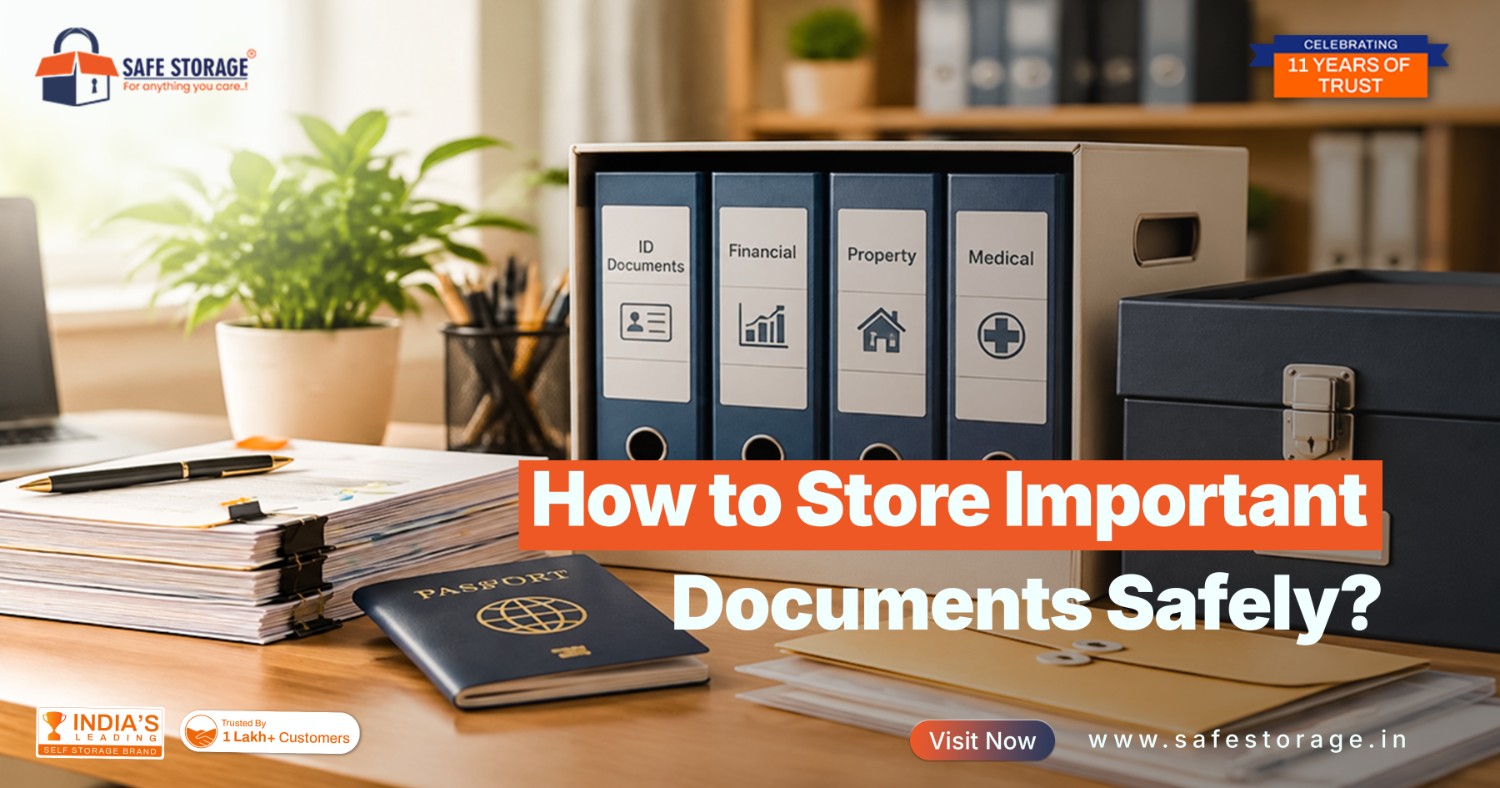
How to Store Important Documents Safely?
Store important documents safely by keeping them dry, off the floor, organised in a written index, and separated so that a single fire, flood or theft cannot take everything at once. Originals belong somewhere secure and controlled. Copies belong somewhere else entirely.
That is the short answer. The longer one matters because most people lose documents in ways that have nothing to do with theft. Paper is destroyed by damp, by silverfish and termites, by being stacked in a loft that gets to fifty degrees, and by nobody being able to find it when it is needed. This guide covers what to keep, how long to keep it, where to keep it, and how to store important documents safely without turning a cupboard into an archive.
Running out of space for files? Get a quote — 8088848484
Which Documents Actually Need Protecting?
Not everything deserves the same care, and treating it all identically is why people end up with four cartons of paper they cannot navigate.
1. Irreplaceable originals
Property sale deeds, registered agreements, share certificates, original wills, birth and marriage certificates, educational degrees and mark sheets, insurance policy originals. These are the ones where losing the paper creates a real legal or administrative problem, sometimes a lawsuit.
2. Replaceable but painful
PAN and Aadhaar copies, passports, bank statements, loan agreements, vehicle registration papers, medical records. Losing these is recoverable but costs weeks of running around, and some cannot be reissued quickly.
3. Business and statutory records
Books of account, invoices, GST records, contracts, employee files, board resolutions, audit papers. These are kept because the law requires them to be kept, and the volume grows relentlessly.
4. Things you can throw away
Expired warranties, old utility bills beyond a year, duplicate copies of things you already hold digitally. Being honest about this category is the single fastest way to make the rest manageable.
How Long Should You Keep Documents?
Retention rules vary and are worth confirming with your chartered accountant, but a few are commonly applied in India.
Income tax records are generally retained for six years from the end of the relevant assessment year, and longer where reassessment is possible. Companies are commonly required to preserve books of account for eight financial years. GST records are usually kept for seventy-two months from the annual return due date. Employee records and contracts are typically held for the duration of employment plus several years afterwards.
Property documents are different. Sale deeds, title papers, mutation records and possession certificates should be kept permanently. They do not expire, and a buyer twenty years from now will want to see them.
The practical consequence is that a household or a small business accumulates paper faster than it discards it. That is what eventually forces the question of where all of it should live.
What Actually Destroys Documents in Indian Conditions
This is the part most advice skips, and it explains why so many documents are lost without anyone stealing anything.
Humidity is the biggest single threat. Paper is hygroscopic, meaning it absorbs moisture from the air. Through a monsoon, files stored in a cupboard against an outside wall will cockle, stain and eventually stick together. Ink bleeds. Once mould takes hold in a stack of paper, it moves through the whole stack, and the smell never leaves.
Pests are the second. Silverfish eat paper and the starch in bindings. Termites go through cardboard cartons and the documents inside them without any visible warning until the carton is opened. Rodents shred paper for nesting.
Then heat. Lofts, store rooms above kitchens and metal almirahs in direct sun reach temperatures that make paper brittle and fade ink, particularly thermal printed receipts, which can go completely blank in a couple of years.
And finally the mundane causes: water seepage from a bathroom wall, a leaking terrace during heavy rain, a burst overhead tank, and simple misplacement. More documents are lost to disorganisation than to disaster.
How to Store Important Documents Safely at Home
If you are keeping documents at home, a few habits do most of the work.
Keep paper off the floor and away from external walls, since both are where moisture arrives first. Use a cupboard on an internal wall rather than a loft or a store room.
Store documents in rigid boxes rather than plastic covers or polythene. Sealed plastic traps whatever moisture was present when you closed it and gives it months to work, which is the same mistake people make with furniture. Paper needs to breathe.
Separate by category and label the outside of every box. An index sheet inside the lid listing contents takes ten minutes and saves hours later.
Never fold original property documents repeatedly along the same line, since paper fails at the crease first. Keep large documents flat.
Scan everything important and keep the digital copy somewhere separate from the original. This single step converts most document losses from a crisis into an inconvenience.
And separate the risk. Keeping every original in one cupboard means one fire or one flood takes all of it. Property originals in one place, financial papers in another, and digital copies in a third is a far more resilient arrangement than a single very secure box.
Home Storage, Bank Locker, or Professional Document Storage?
Each suits a different problem, and most households and businesses eventually use more than one.
A home cupboard is convenient and free, and it is fine for documents you need frequently and for a modest volume. It is a poor choice for irreplaceable originals in a humid climate, and it stops working entirely once the volume grows past a shelf or two.
A bank locker suits a small number of high-value irreplaceable items: property originals, share certificates, jewellery-related papers. It is secure and it is small. It is not a solution for forty cartons of invoices, and access is limited to banking hours.
Professional document storage is built for volume and duration. Records are boxed, barcoded, inventoried and kept in a facility that is ventilated and pest-controlled, with each carton traceable so you can retrieve a specific file rather than searching through everything. This is what businesses use for statutory records and what households use when property papers, old tax files and family documents have outgrown the cupboard.
Files outgrown your office? Document storage from 24 a month— safestorage.in
What Professional Document Storage Costs
With SafeStorage, document storage starts at 24 per month, which is the lowest-priced plan offered and reflects the fact that paper is dense and stacks efficiently. Business storage for mixed records and equipment starts at 32 per month.
What drives the figure is volume and duration, the same as any storage. What matters more for documents specifically is retrieval: how quickly you can get a particular file back, and whether you can request one carton without disturbing the rest. Ask about that before comparing rates, because for records it is the whole point.
Compared with the alternative, the arithmetic is straightforward. Office floor space in any Indian city costs several times what document storage does per square foot, and a room full of archive cartons is a room you are paying commercial rent on to hold paper nobody looks at.
How Document Storage Works
You call 8088848484 or request a quote at safestorage.in and describe roughly how many cartons or files you have and how long you need them stored.
The team collects from your home or office with packing material. Records are boxed, barcoded and inventoried as they are collected, so both sides have a record of exactly what was handed over. Goods travel in SafeStorage vehicles to a secured, pest-controlled facility with insurance included in the plan.
When you need a specific file or carton, you request it and it is delivered. You are not required to retrieve everything to reach one document, which is the difference between a storage service and a locked room.
A Practical Order to Do This In
Sort first, into the four categories above. Discard what genuinely does not need keeping, because you are otherwise paying to store it.
Scan the irreplaceable originals and the documents you refer to often, and store the digital copies separately from the paper.
Box what remains by category, label every box, and put an index inside each lid.
Keep the small number of frequently needed originals accessible at home or in a locker. Send the bulk — old tax files, statutory records, closed contracts, archived invoices — to document storage, where the conditions are better than a cupboard and the cost is lower than the room it currently occupies.
Frequently Asked Questions
1. How do I store important documents safely?
Keep them dry, off the floor, in rigid boxes rather than sealed plastic, organised with a written index, and separated so one incident cannot destroy everything. Scan the irreplaceable ones and keep digital copies somewhere different from the originals.
2. Where is the safest place to keep original property documents?
Somewhere controlled and dry, with the risk separated. A bank locker suits a small number of irreplaceable originals. Professional document storage suits larger volumes. Whichever you choose, keep scanned copies elsewhere so loss of the paper is not loss of the record.
3. How long should business records be kept in India?
Commonly six years for income tax records from the end of the assessment year, eight financial years for company books of account, and seventy-two months for GST records. Confirm the specifics with your chartered accountant, as requirements vary by entity and situation.
4. Can documents be damaged in storage?
In a poorly ventilated space, yes. Humidity causes cockling, staining and mould, silverfish and termites eat paper and bindings, and heat makes paper brittle. A properly run facility with ventilation, raised storage and pest control avoids all three.
5. How much does document storage cost?
SafeStorage document storage starts at 24 per month, with business storage for mixed records from 32. The final figure depends on volume and duration. Ask about retrieval terms too, since for records the ability to get one carton back matters more than the rate.
6. Can I get one file back without retrieving everything?
Yes. Because every carton is barcoded and inventoried at collection, you can request a specific box and have only that delivered. This is the main practical difference between document storage and simply renting a locked room.
7. Should I scan documents instead of storing them?
Scan as well, not instead. Digital copies protect against loss and make retrieval instant, but originals of property deeds, registered agreements, share certificates and wills carry legal weight that a scan does not. Keep both, in different places.
8. Is document storage suitable for small businesses?
Yes, and it is one of the most common uses. Statutory records accumulate faster than any office can absorb, and archive cartons sitting in a commercial space are occupying floor area that costs several times what storage does.
9. Are stored documents confidential?
Records are boxed and sealed at collection, barcoded, and retrieved only on your instruction. Ask any provider how access is controlled and who can authorise a retrieval before you hand over sensitive files.
10. How do I arrange document storage?
Call 8088848484 or request a free quote at safestorage.in. Describe roughly how many cartons or files you have and how long you need them stored, confirm the price, and schedule a pickup from your home or office.
Final Thoughts
Most people think about document security in terms of theft, and then lose papers to a monsoon, a termite colony or a cupboard nobody had indexed. The practical threats are dull and they are the ones worth planning for.
So sort honestly, discard what you can, scan what matters, and store important documents safely in conditions that are actually suitable for paper rather than merely convenient. For a household that usually means a locker plus digital copies. For a business it usually means getting the archive out of a room you are paying commercial rent on and into a facility built for it.
Need somewhere safe for your documents and records?
Document storage from 24 per month, with doorstep pickup, barcoded inventory and insurance included. Tell us roughly how many cartons you have and we will quote it and collect it.
Call 8088848484 | Visit safestorage.in

💬 Comments
Leave a Comment