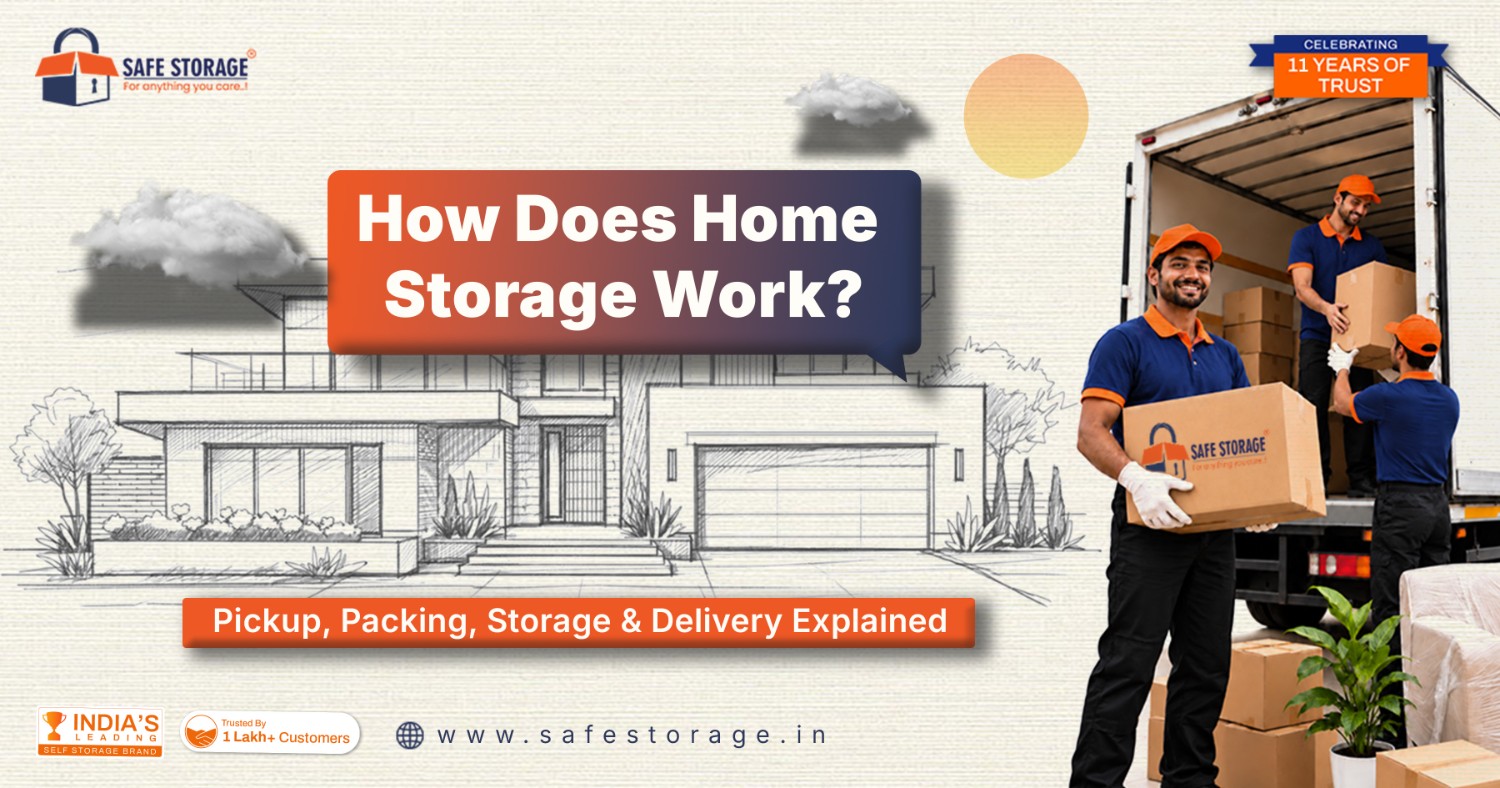
How Does Home Storage Work? Pickup, Packing, Storage & Delivery Explained
Home storage works by collecting your belongings from your doorstep, packing and transporting them to a secure storage facility, storing them safely, and delivering them back whenever you need them. You never have to hire a truck, rent a unit you drive to, or carry a single box yourself. With SafeStorage, doorstep pickup, 3-layer packing, barcode tracking and free insurance are included, and household plans start at 799 a month.
Here is exactly how the process runs, what you can store, how much space and money to budget for, and the mistakes worth avoiding before you book.
How Does Home Storage Work?
From your first enquiry to the day your belongings come back, home storage follows seven steps.
1. Choose what you want to store. Walk through your home and list the furniture, appliances and boxes that need to move out. A rough list is enough to start with; it gets refined during the survey.
2. Select the required storage space. Based on that list you pick a plan by home size (1 RK, 1 BHK, 2 BHK or 3 BHK), or pay per square foot if you want to match your exact volume.
3. Schedule doorstep pickup. You choose a date and a slot. Trained packers come to your address, so there is no vehicle to arrange and no labour to hire.
4. Packing and protection. Items are packed at your home with 3-layer secure packing. Fragile pieces, mattresses, sofas and appliances each get protection suited to their shape and material.
5. Transportation to the storage facility. Packed goods are loaded into SafeStorage vehicles and taken straight to the warehouse.
6. Safe storage and inventory. Every item is inventoried and barcoded, then stored in a monitored, pest-controlled, climate-controlled facility. Your list stays visible on the live updates dashboard.
7. Request delivery when needed. When you want some or all of your belongings back, you raise a request and the team schedules delivery to your address, typically within a week.
What Can You Store in Home Storage?
Almost everything an ordinary household owns can go into storage. The common categories are:
1. Furniture: wardrobes, dining sets, study tables, shoe racks and bookshelves. Large pieces are dismantled where possible to protect the joints and save space. See household storage for what is covered.
2. Sofas: wrapped against dust and moisture, and stored so cushions are not crushed under heavier items.
3. Beds and mattresses: frames are dismantled, and mattresses are packed flat or upright in protective covers.
4. Appliances: refrigerators, washing machines, televisions, microwaves and air conditioners. Drain and dry anything that holds water before pickup.
5. Household items: kitchenware, utensils, decor, lamps, curtains, rugs and clothing.
6. Documents: personal files and certificates can travel with your household goods, while larger archives suit dedicated document storage from 24 a month.
7. Seasonal items: winter wear, festival decor, bicycles, travel gear and sports equipment you use only a few months a year.
8. Moving boxes: packed cartons of books, toys and personal belongings. If you only have a few, box storage starts at 99 a month.
Perishable food, flammable liquids, gas cylinders, cash, jewellery and anything illegal cannot be stored. If you are unsure about a particular item, ask while you are getting your quote.
How Much Home Storage Space Do I Need?
The quickest way to estimate is to match your requirement to the size of the home the items are coming from. Here is what each home size usually holds, and the plan that normally fits it.
1 RK homes typically send a bed, a small wardrobe, a couple of appliances and 10 to 15 cartons into storage, which fits the 1 RK plan of up to 150 sq ft. 1 BHK homes usually mean furniture plus boxes, and fit the 1 BHK plan of up to 350 sq ft. 2 BHK homes add a second bedroom set and the larger appliances to that list, and fit the 2 BHK plan of up to 650 sq ft. 3 BHK homes move full household contents, which needs the 3 BHK plan at 1,000+ sq ft, where custom sizing is available.
Those brackets are only a starting point, because two 2 BHK homes can hold very different volumes. Follow these five steps to arrive at a number you can actually book against.
1. Walk through room by room and write everything down. Do one room at a time, starting with the bedrooms, and list every item you intend to store. Working room by room stops you from forgetting the balcony, the loft and the store room.
2. Count the big pieces first. Wardrobes, beds, sofas, dining tables, refrigerators and washing machines account for most of your volume, and boxes simply fill the gaps around them. If you have eight or more large pieces, you are already past a 1 BHK plan.
3. Estimate your cartons honestly. A lightly furnished 1 BHK typically needs 15 to 20 cartons, a 2 BHK needs 30 to 40, and a family 3 BHK can easily cross 60. Undercounting here is the single most common reason a booked plan turns out too small.
4. Subtract what is not going into storage. Anything moving to the new home, being sold, being donated or being thrown out should come off the list before you size the plan. People routinely store furniture they had already decided to replace.
5. Get a survey and confirm the plan. Share your final list with the team and ask them to size it. They will tell you which plan fits, so you are neither paying for empty space nor squeezing a 3 BHK worth of goods into a 2 BHK plan.
If your list sits right on the boundary between two plans, mention it during the survey. Square-foot pricing exists precisely for households that do not fit neatly into a BHK bracket.
How Much Does Home Storage Cost?
SafeStorage household storage starts at 799 a month for a 1 RK plan of up to 150 sq ft, 1,299 a month for a 1 BHK plan of up to 350 sq ft, 3,499 a month for a 2 BHK plan of up to 650 sq ft, and 5,499 a month for a 3 BHK plan of 1,000+ sq ft with custom plans available. If you prefer to pay for exact volume, square-foot pricing starts at 28 per sq ft a month, and for a handful of cartons box storage starts at 99 a month. All of it is listed on the pricing page.
What moves your final quote up or down:
1. Storage space or volume: the more space your goods occupy in the warehouse, the higher the monthly rent.
2. Storage duration: the minimum is one month with no lock-in, and longer commitments qualify for long-term discounts.
3. Number of items: a few large pieces and dozens of small cartons can occupy very different volumes.
4. Pickup and transport: doorstep pickup is part of the service, though distance from the facility and floor access can affect the quote.
5. Packing requirements: 3-layer packing is standard, and extra protection can be added for delicate or high-value pieces.
6. Delivery requirements: whether you want everything back in one go or a few items at a time.
There is no security deposit, no lock-in and no hidden charge, and insurance is included free. Rates vary slightly by city, so the accurate number for your address comes from a free quote. SafeStorage operates in 16+ cities including Bengaluru, Mumbai, Delhi, Hyderabad, Chennai, Pune, Kolkata, Noida, Gurugram, Coimbatore, Jaipur, Ahmedabad, Lucknow, Patna, Visakhapatnam and Kochi; you can check your city on the locations page.
Is Home Storage Better Than Keeping Everything at Home?
Keeping everything at home adds nothing to your monthly bill, but it is not free either. Unused furniture occupies floor space you are already paying rent or EMI on, and in a metro that space is expensive. Here is how the two options compare in the situations people actually face.
1. Renovation: keeping items at home means shifting furniture from room to room while carpenters, painters and dust move through. Home storage clears rooms completely, so work finishes faster and nothing gets scratched or stained.
2. Moving between homes: when the old lease ends before the new flat is ready, storage bridges the gap. The alternative is paying for a bigger temporary place or leaning on relatives.
3. Downsizing: moving from a 3 BHK to a 2 BHK usually leaves furniture you are not ready to sell. Storage buys you time to decide instead of cramming the new home.
4. Travelling: for a long trip, storing your belongings and giving up a rented flat often costs far less than paying rent on an empty home.
5. Temporary relocation: a one or two-year posting in another city does not have to mean selling everything you own.
6. Lack of space: a growing family, a new work-from-home desk or a room converted for an elderly parent are all solved by moving seldom-used items out.
The simple test: if you use an item every week, keep it at home. If you have not touched it in months and it still takes up a corner, storage is the cheaper answer.
Who Needs Home Storage?
1. Families who want a spare room back, or who are between homes during a move.
2. Students leaving hostels and PGs during semester breaks or internships in another city.
3. People moving homes whose move-out and move-in dates do not line up.
4. People renovating a kitchen, a bathroom or an entire flat.
5. Expats and NRIs heading abroad who want their household kept intact for their return.
6. People relocating for work on a temporary or open-ended assignment.
7. Businesses needing room for stock, equipment or records, which is covered by business storage from 32 a month.
How Safe Is Home Storage?
Safety is the first thing most customers ask about. Here are straight answers.
1. How are items protected?
SafeStorage facilities have 24/7 CCTV surveillance, biometric access control, fire detection and suppression systems, and regular pest control. Climate-controlled units help protect electronics, wooden furniture and documents from heat and humidity, and every item is covered by free insurance at no extra cost.
2. How are belongings tracked?
Each item is inventoried and barcoded at pickup, so the warehouse knows exactly what you stored and where it sits. You can see your stored goods through the live updates dashboard rather than relying on a handwritten list.
3. Can I access my items?
Yes. You can request specific items instead of your entire consignment, so retrieving one carton does not mean taking everything back.
4. How does delivery work?
You raise a delivery request, choose a date, and the team delivers to the address you specify. Deliveries are typically completed within one week of the request.
5. What happens if I need an item urgently?
Call 8088848484 as soon as you know. Because every item is barcoded, it can be located quickly and the team will confirm the earliest available slot. For anything you might need at short notice, such as tax papers or a particular appliance, say so at pickup so it is labelled and kept easy to reach.
Home Storage During Moving or Renovation
Moving and renovation are where home storage saves the most time and stress. The sequence usually looks like this:
1. Moving out: the team packs your home and picks up everything you will not need for the next few weeks or months.
2. Temporary storage: your goods sit in the warehouse while you stay with family, in a service apartment or in a smaller rental.
3. Renovation: contractors get empty rooms, which means faster work, no furniture damage and no dust settling into your sofa.
4. New or refreshed home: once painting, flooring or handover is done, you pick a delivery date.
5. Delivery: your belongings arrive at the new address, ready to be placed room by room.
If you are shifting cities as well, SafeStorage packers and movers can handle the move while storage holds whatever the new home is not ready for. For more ideas, read our guide to smart storage solutions during a home renovation.
Short-Term vs Long-Term Home Storage
1. Short-term home storage means one to a few months. It suits renovations, gaps between leases, semester breaks and festival-season decluttering. Because the minimum is one month with no lock-in, you only pay for the time you actually use.
2. Long-term home storage means six months or more. It fits overseas postings, extended travel, downsizing and inherited furniture you are not ready to part with. Long-term commitments qualify for discounts, and climate-controlled storage matters more over a longer period, because humidity and pests do their damage slowly.
If you are not sure how long you will need, start with a monthly plan and extend it. Nothing forces you to commit upfront.
Common Home Storage Mistakes
1. Choosing too much space: booking a 3 BHK plan for a lightly furnished 2 BHK means paying for empty air every month. Get a survey before you commit.
2. Not making an inventory: without a list it is easy to forget what went in. Check the barcoded inventory at pickup and keep your own copy.
3. Poorly packed fragile items: glassware, mirrors and televisions need real cushioning. Let trained packers handle them, or use proper packing materials if you pack yourself.
4. Choosing on price alone: a cheap godown with a lock and key gives you no CCTV, no pest control, no item tracking and no insurance. One damaged wardrobe costs more than the saving.
5. Not checking pickup and delivery terms: confirm what is included, how delivery requests are raised and how long they take before you book.
6. Storing appliances wet or dirty: defrost refrigerators and drain washing machines at least a day before pickup, or you will get mould and odour.
Home Storage FAQs
1. How does home storage work?
The storage company picks up your belongings from your home, packs them, transports them to a secure warehouse, stores them with an item-level inventory, and delivers them back whenever you request them.
2. How much does home storage cost?
SafeStorage household plans start at 799 a month for a 1 RK, 1,299 for a 1 BHK, 3,499 for a 2 BHK and 5,499 for a 3 BHK. Square-foot pricing starts at 28 per sq ft a month and box storage starts at 99 a month.
3. Can furniture be stored?
Yes. Beds, sofas, wardrobes, dining sets and other furniture are dismantled where needed, wrapped with 3-layer packing and kept in climate-controlled, pest-controlled facilities.
4. Can I store my belongings for one month?
Yes. The minimum duration is one month and there is no lock-in contract, so short-term storage is fully supported.
5. Does home storage include pickup?
Yes. Doorstep pickup is part of every SafeStorage household plan, along with packing, barcode tracking and free insurance.
6. How much storage space do I need for a 2 BHK?
A typical 2 BHK with furniture, appliances and boxes fits the 2 BHK plan of up to 650 sq ft. A lightly furnished home may need less, so ask for a survey before booking.
7. Can I get my belongings delivered when I need them?
Yes. Raise a delivery request and the team schedules delivery to your address, typically within a week. You can also ask for specific items rather than everything.
8. Is home storage suitable during renovation?
Yes. Moving furniture and appliances off-site clears rooms for contractors and protects your belongings from dust, paint and accidental damage.
9. What household items can I store?
Furniture, appliances, mattresses, kitchenware, clothing, books, documents, seasonal items and packed cartons. Perishables, flammables, gas cylinders and valuables such as cash and jewellery should not be stored.
10. How do I choose a home storage company?
Check for doorstep pickup and delivery, item-level tracking, CCTV and access control, pest control, insurance, transparent pricing with no hidden fees, flexible duration and verified customer reviews.
Need Extra Space at Home?
Whether you are moving, renovating, downsizing or simply running out of space, choose a storage option that fits your belongings and your duration. Get a storage quote from SafeStorage today, with doorstep pickup, free insurance and household plans from 799 a month.
💬 Comments
Leave a Comment