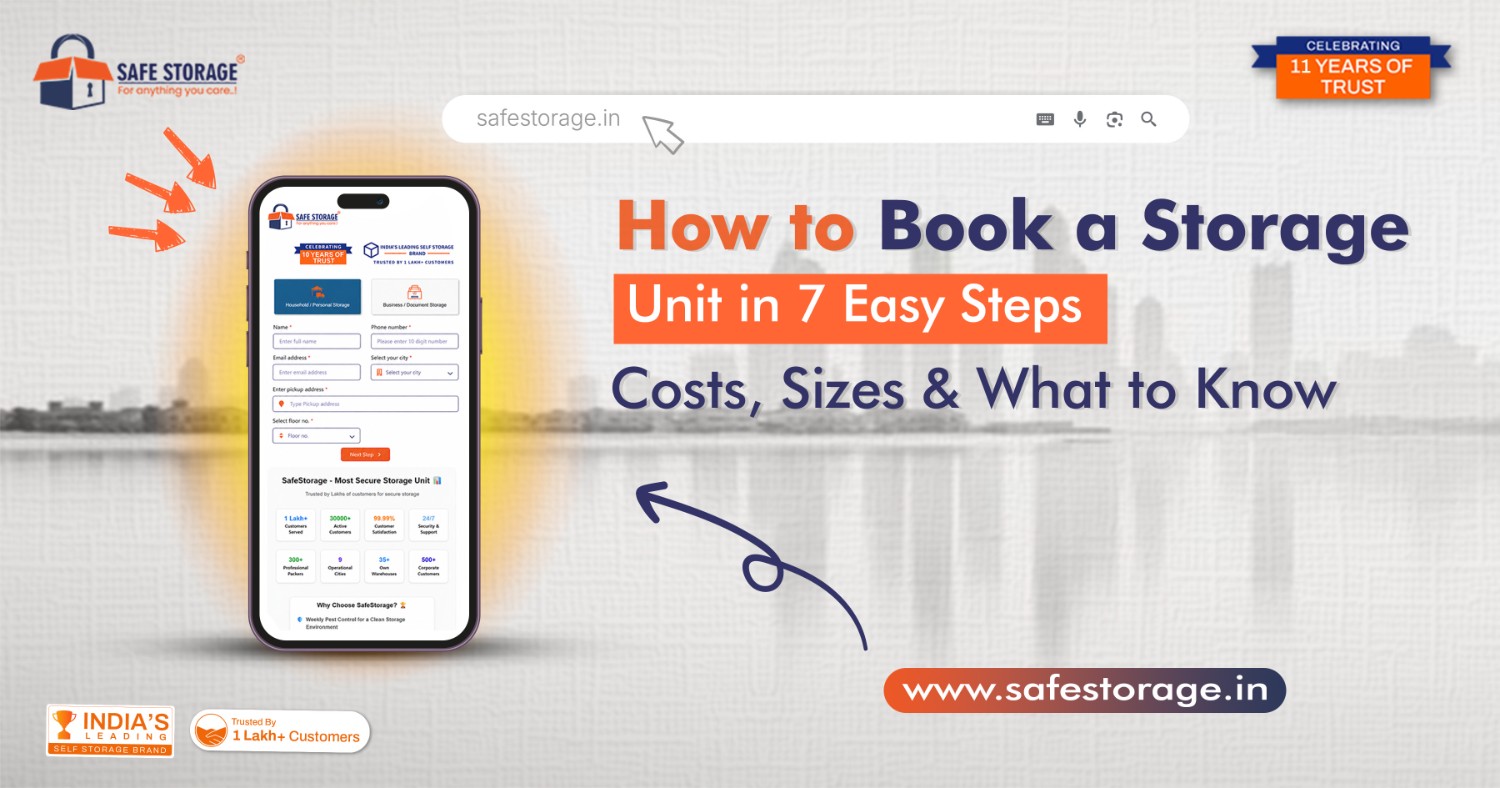
How to Book a Storage Unit in 7 Easy Steps: Costs, Sizes & What to Know
Introduction
The first time you book a storage unit, it feels stranger than it should. You are about to hand your sofa, your fridge, and a few things you would hate to lose to a company you found online this morning, and the doubts start stacking up. What will it cost? How big a unit? Will any of it come back scratched? And do I really have to carry all this myself? Here is the reassuring bit: with a properly managed provider, it is far less trouble than it looks. This guide takes you through the whole thing in seven steps, and clears up the cost, size, and safety questions that snag most first-timers, so you can book without that nagging second-guess.
What Is Self-Storage, Really?
Worth a quick word before the steps, just so you know what you are paying for. Self-storage is space you rent to keep your belongings safe away from home, usually in a secure warehouse, for as long as you need. It comes in two shapes. The old-school kind hands you a unit and a key and leaves the truck, the packing, and the trips to and fro entirely to you. The managed kind, which is what we do at SafeStorage, takes the awkward parts off your plate: a crew turns up, packs your goods, moves them, and stores them somewhere monitored, so you never rent a tempo or set foot in a warehouse. In a city where nobody has a spare afternoon, that second version is the one that actually gets used.
How to Book a Storage Unit in 7 Easy Steps
Here is the whole thing, start to finish. With a managed provider, most of it happens without you picking up anything heavier than your phone.
Step 1: Figure out what is going in. Before you ring anyone, run a rough tally in your head. A few boxes and a bed, or a whole 2 BHK worth? That one answer shapes both the size and the price. It is also the moment to be honest about what you actually want back, because there is no point paying to store the things you have been meaning to give away for a year.
Step 2: Ask for a quote. Call or fill in the form online and describe what you have. A straight provider comes back with an itemised quote built around your actual goods, not a woolly monthly number. This is your moment to compare, poke at the details, and ask the awkward questions.
Step 3: Lock in the plan and the date. Settle on the size that fits, agree a pickup day, and get the terms in plain writing: the monthly cost, the minimum stay, and how much notice you need to give to get everything back. Nail this down before you commit, not after.
Step 4: Packing at your doorstep. On the day, the crew shows up with the proper materials and wraps everything: furniture padded, fragile bits cushioned, boxes labelled. It sounds routine, but this is where most damage is quietly prevented, so it deserves more attention than people give it.
Step 5: Tagging and inventory. Every item gets logged and tagged against your account, so there is a written record of exactly what went in. That record is the whole reason nothing goes missing between drop-off and pickup.
Step 6: Off to the warehouse. Your goods are loaded and taken to a clean, monitored, climate-appropriate space. From here your part is essentially done; the cameras and the controlled access take over while your things simply sit and wait.
Step 7: Get it back when you want it. Need your things? Ask, and they come back to your door. No queue at a gate, no dragging cartons down a stairwell. It ends as smoothly as it began.
How Much Does a Storage Unit Cost?
Cost is what everyone asks first, and the truthful answer rests on two things: how much room your goods take up, and how long they stay. A dozen boxes will always cost a fraction of a full house, and a longer booking usually earns a better monthly rate than a fortnight does. Then there are the parts people forget to check. Does the price include pickup, packing, transport, and insurance, or do those land as separate lines later? A cheap-looking headline can fatten up fast once they do. So push for an itemised quote, see exactly where your money is going, and you will not be caught out on billing day.
What Size Storage Unit Do I Need?
Size is the thing first-timers most often misjudge, either renting a cavern they never fill or squeezing a home into a cupboard. The easiest yardstick is your home. A 1 RK or 1 BHK usually fits a small unit, a 2 BHK a medium one, and a 3 BHK or bigger needs more again. Then the odd stuff nudges it, a couple of bikes, the extra appliances, that tower of boxes nobody counts. Honestly, the simplest move is to let the provider look at what you have and suggest the size, so you pay for the space you use and not a square foot more. Any decent managed provider will do this without being asked.
What Can I Store (and What I Can't)?
Most of what fills a home or an office is completely fine: furniture, mattresses, appliances, electronics, clothes, books, papers, kitchen things, the seasonal clutter, all of it stores well when it is packed properly. Businesses tuck away stock, equipment, files, and old records. But there are limits, and they are common sense. Food that can spoil, plants, anything alive, none of that belongs in a storage unit. Nor does anything hazardous, flammable, or illegal, for reasons that need no explaining. If a particular item leaves you unsure, just ask before pickup day. Checking takes a minute; guessing wrong can cost you.
Is My Stuff Safe? Security Explained
This is the question sitting underneath all the others, so here is the honest version. In a properly run facility your things are safe because safety is layered, not pinned on a single padlock. You want an enclosed, watched warehouse rather than an open yard, cameras running around the clock, entry limited to staff who are meant to be there, and every item tagged to your account so it is all on record. Fire precautions matter, and so does keeping damp and pests out, which counts for a lot in our humid weather. Insurance is the last line, there for the rare day something slips through. Put all of that together and storage is often safer than an empty flat with your things sitting in it.
Short-Term Storage: For the In-Between Moments
Storage is not always a long-haul thing. Life keeps handing us gaps: the new place is not ready, the flat is mid-renovation, work has parked you in another city for a few weeks, or you are knee-deep in a clear-out with nowhere to put the overflow. Short-term storage exists for exactly these stretches. You get the same pickup, packing, security, and insurance; you simply keep it for less time. It is genuinely handy, and oddly underused, since people tend to cram a spare room or lean on a relative's garage when a few weeks of proper storage would be safer and a good deal less stressful.
Business Storage: Space That Scales With You
Households are not the only ones who run out of room. Growing businesses hit the space wall long before they are ready to sign for a bigger office, and storage fills that gap without a heavy lease. Companies park surplus stock, seasonal inventory, gear, marketing material, and the archived files they must keep but almost never open. With everything tagged and shelved in an organised warehouse, it stays trackable and easy to pull back, so the space works like an extension of the business rather than a hole you posted things into. For a lot of small and mid-sized firms, it is simply the cheapest way to breathe.
Pickup and Delivery: The Part That Changes Everything
If one feature separates a modern managed service from the old key-and-unit model, this is it: they come to your door, both ways. No hunting for a vehicle, no roping in friends, no wrestling a wardrobe across town. A trained crew arrives, packs, loads, and moves it, then brings it back when you say so. For anyone without a big enough vehicle, or just without a spare day and a strong back, this is the whole difference between storage as a headache and storage as an easy errand. It is the quiet reason managed storage caught on the way it did.
Booking Storage With SafeStorage
Pull it all together and booking with SafeStorage really is as simple as those seven steps make it sound. You tell us what needs storing, we come back with a clear and honest quote, and from there we handle the pickup, the packing, the tagging, the transport, and the warehousing. Your goods sit in a monitored, climate-appropriate space with insurance already included, and they come home to your door whenever you are ready. A few boxes for a month or a whole house for a year, the goal does not change: take the stress out of storage completely, so you can get on with whatever is next.
Frequently Asked Questions
1. How do I book a storage unit?
Tally up what is going in, ask for an itemised quote, choose a plan and a pickup date, and let the provider pack, tag, move, and store it. With a managed service like SafeStorage, most of that happens at your doorstep and you barely lift a thing.
2. How much does storage cost?
Mostly it comes down to how much room your goods take and how long they stay, with longer bookings often cheaper per month. Just check whether pickup, packing, transport, and insurance are in the price, and ask for it itemised.
3. What size unit do I need?
Rough guide: a 1 RK or 1 BHK wants a small unit, a 2 BHK a medium one, a 3 BHK or bigger more again. Easiest of all is to let the provider look at your goods and suggest a size, so you only pay for what you use.
4. Is my stuff safe in storage?
In a properly run facility, yes, an enclosed monitored warehouse, cameras around the clock, controlled access, item tagging, fire precautions, and insurance. Layered like that, it is often safer than leaving everything in an empty home.
5. What can't I store?
Nothing perishable, no plants, nothing alive, and nothing hazardous, flammable, or illegal. If you are unsure about a particular item, just ask before your pickup day rather than guessing.
6. Can I store for just a short time?
Yes. Short-term storage suits the gaps between homes, a renovation, or a few weeks in another city, with the same pickup, packing, security, and insurance as a longer stay.
7. Do I have to move everything myself?
Not with managed storage. A crew handles doorstep pickup, packing, transport, and the delivery back to you, so there is no truck to hire and no trip to a facility.
Ready to Book Your Storage?
Storage should lighten your load, not add to it. SafeStorage looks after pickup, packing, tagging, transport, and secure storage, insurance included, so booking a unit really is as easy as the seven steps you just read. Moving, renovating, clearing out, or making room for a growing business, leave the heavy part to us.
Call 8088848484 | Visit safestorage.in


💬 Comments
Leave a Comment